 Guide
Guide
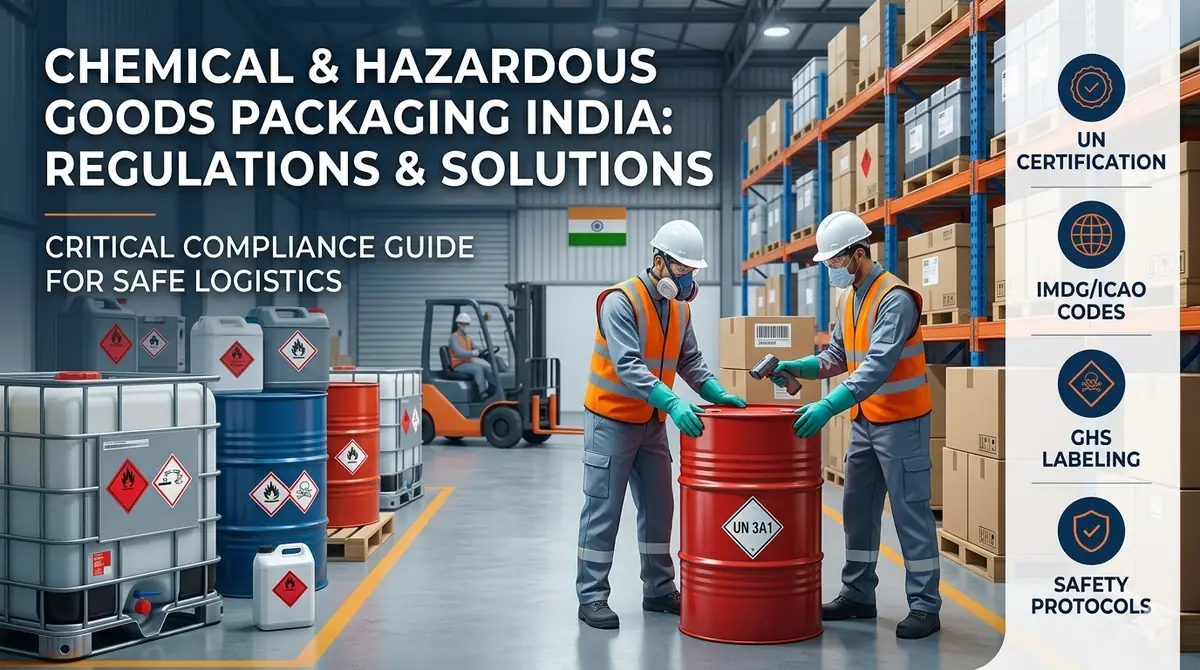
Chemical and Hazardous Goods Packaging India: Safety and Regulatory Guide
Packaging hazardous chemicals incorrectly in India can result in regulatory penalties, courier/freight rejection, insurance voidance, and — most importantly — transport accidents. The regulatory framework is clear; the implementation is often incorrect at Indian SME level.
---
The Regulatory Framework in India
Hazardous goods packaging for road transport in India is governed by:
Central Motor Vehicles Rules (CMVR): Part of the Motor Vehicles Act — specifies requirements for carrying hazardous goods by road.
The Hazardous and Other Wastes (Management and Transboundary Movement) Rules 2016.
IATA DGR (for air freight): International Air Transport Association Dangerous Goods Regulations.
IMDG Code (for sea freight): International Maritime Dangerous Goods code.
For domestic road transport: CMVR and the Manufacture, Storage and Import of Hazardous Chemical Rules are the primary frameworks.
---
UN-Rated Packaging
Most hazardous chemical packaging for transport requires UN-rated packaging — tested and certified to withstand the specific hazards of the contents.
UN ratings appear on packaging as: UN mark + a code indicating: material type (1 = fibreboard/corrugated), packaging design number, performance level (X = Packing Group I highest hazard, Y = PG II, Z = PG III), maximum weight, year of manufacture, country of origin, manufacturer code.
Example: UN/1G/Y3.5/S/23/IN/AB123 = corrugated box, suitable for PG II and III solids, 3.5 kg maximum gross weight, solid content, manufactured 2023, India.
For most industrial chemicals: Packing Group II (Y) or Packing Group III (Z) corrugated boxes are the standard. Contact Upackarts for UN-rated corrugated packaging specifications.
---
Inner Packaging Requirements
The outer UN-rated corrugated box contains the immediate container (glass bottle, plastic jerry can, metal drum) plus inner packaging material.
For liquids: The primary container must be sealed and upright. A secondary sealed bag (HDPE poly bag) surrounds the primary container. Sufficient absorbent material (perlite, vermiculite, or absorbent pads) to absorb the full volume of the primary container must fill the space between the secondary bag and the outer box.
Upackarts HDPE Poly Bags: upackarts.in/products/hdpe-poly-bags/
For solids and powders: HDPE poly bag inner liner heat-sealed before placement in corrugated outer. Double bagging for very hazardous powders.
---
Absorbent Material Requirements
For liquid chemical packaging: absorbent filling material between the secondary containment bag and the outer corrugated box must be capable of absorbing the full contents of the primary container. This ensures no liquid escapes the outer packaging even in a total primary container failure.
Approved absorbents: vermiculite, perlite, mineral clay, cellulose-based granules, and absorbent pads rated for the specific chemical class.
---
Mandatory Label Requirements for Hazardous Goods
Class diamond labels (DOT/IATA/IMDG hazard class) on two opposite sides of the outer package.
UN number on a white rectangle (background) in black text of minimum 12mm height.
Proper shipping name below UN number.
Net quantity.
Shipper and consignee details.
These labels are in addition to standard shipping address labels — not alternatives to them.
Upackarts Packing List Document Pouches: upackarts.in/products/packing-list-document-pouches/
---
Frequently Asked Questions
Do I need UN-rated packaging for all chemical shipments in India?
UN-rated packaging is required for materials classified as hazardous goods under the relevant transport regulations. For non-hazardous industrial chemicals (cleaning agents, food-grade additives): standard corrugated packaging with appropriate secondary containment. For materials on the hazardous goods list: UN-rated packaging is mandatory for road, rail, sea, and air freight.
What is the difference between Packing Group I, II, and III?
Packing Group I: High hazard materials — most dangerous. Requires the most robust packaging (higher UN code performance level X). PG II: Medium hazard. Standard for many industrial acids and solvents. PG III: Low hazard. Least stringent packaging requirements. The hazardous material's Safety Data Sheet (SDS) specifies the correct packing group.
Can I use standard corrugated boxes for chemical shipments?
Standard corrugated boxes are not UN-rated and cannot be used for hazardous goods classification I, II, or III shipments. UN-rated corrugated boxes undergo drop testing, stacking testing, and vibration testing to receive certification. Using standard corrugated for hazardous goods is a regulatory violation and voids transport insurance.
Need Packaging for Your Business in Pune?
Bulk corrugated boxes, wooden crates, and custom packaging at the best prices. Response in 30 minutes.
Related Articles


Get a Quick Quote
Tell us your requirement. Response in 30 minutes.
Request Quote WhatsApp Now- ✔ Reply in 30 minutes
- ✔ GST Invoice included
- ✔ Bulk pricing available
- ✔ Same-day dispatch, Pune