 Guide
Guide
HDPE vs LDPE Poly Bags India: Complete Comparison for Industrial Use
Indian manufacturers and packaging buyers routinely order poly bags without specifying HDPE or LDPE — and end up with the wrong material for the application. The two polymers look similar but have fundamentally different properties that matter in packaging.
---
The Basic Difference
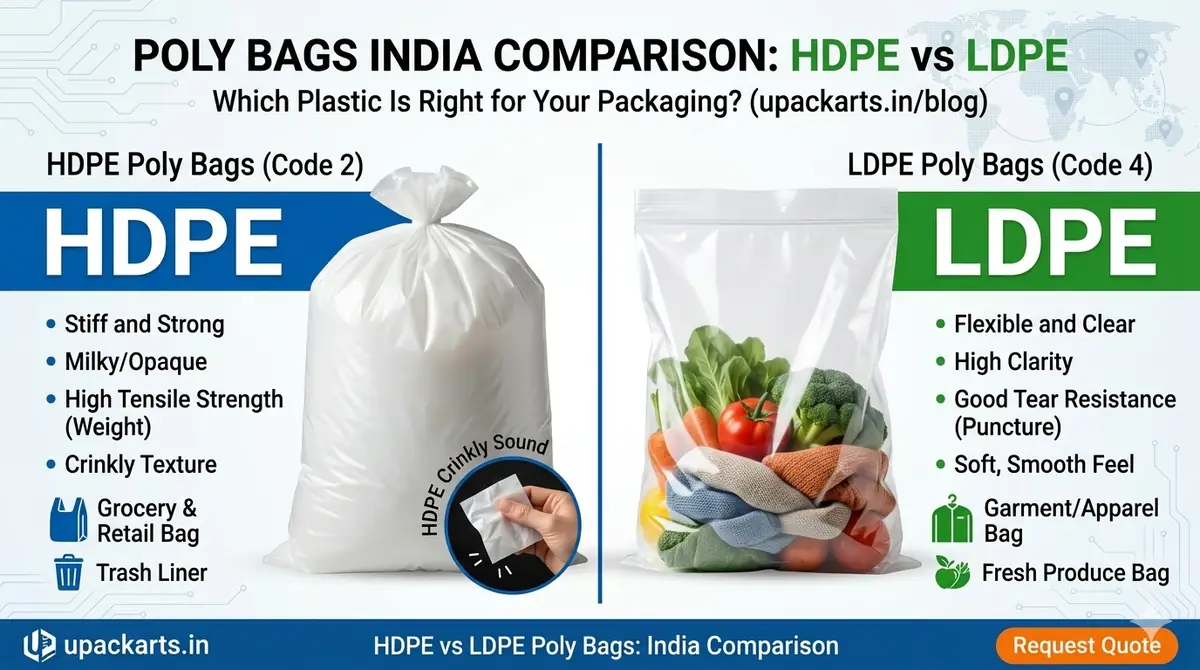
HDPE (High-Density Polyethylene) is a stiffer, denser polymer. HDPE bags crinkle and rustle when handled. They are stronger per micron of thickness and have lower moisture vapour permeability.
LDPE (Low-Density Polyethylene) is softer, more flexible. LDPE bags are quieter, more transparent, and conform more easily to product shapes. They have higher elongation before tearing.
---
Moisture Barrier Performance
This is the most important difference for industrial packaging:
HDPE (50 micron): WVTR approximately 5 to 8 g/m2/day.
LDPE (50 micron): WVTR approximately 8 to 15 g/m2/day.
HDPE provides 30 to 50 percent better moisture barrier at equivalent thickness. For applications where moisture protection is the primary requirement — inner liners for corrugated boxes containing moisture-sensitive components, bearings, precision instruments — HDPE is the correct choice.
Upackarts HDPE Poly Bags: upackarts.in/products/hdpe-poly-bags/
---
Tensile Strength and Puncture Resistance
HDPE is significantly stronger than LDPE per micron:
HDPE (50 micron): Tensile strength approximately 25 to 35 MPa.
LDPE (50 micron): Tensile strength approximately 10 to 20 MPa.
For packaging sharp-edged components (machined parts, metal stampings, hardware) that could puncture lighter bags: HDPE at 75 to 100 micron provides better puncture resistance.
---
Heat Sealing
LDPE seals at lower temperatures (100 to 120°C) with less risk of burning through. HDPE requires 130 to 160°C and more precise temperature control. For operations with standard impulse or bar sealers: LDPE is easier to seal reliably without equipment calibration.
---
Clarity and Presentation
LDPE has higher optical clarity — contents are more visible through the bag. For retail display packaging, product presentation in distribution, and applications where visual inspection of bag contents matters: LDPE is preferred.
HDPE is more opaque (milky or hazy appearance). For industrial packaging where visual content identification is not required: HDPE's superior barrier properties make it the better functional choice.
---
Chemical Resistance
HDPE has better resistance to a broader range of chemicals, solvents, and oils than LDPE. For packaging chemical products, oil-contaminated components, and industrial chemicals: HDPE is the safer choice.
---
Application Guide
| Application | Recommended |
|-------------|-------------|
| Inner liner for corrugated boxes (moisture-sensitive goods) | HDPE 50-75 micron |
| Sharp metal component bagging | HDPE 75-100 micron |
| Powder and granule packing (inside master shipper) | HDPE 50 micron |
| Retail product display packaging | LDPE 40-50 micron |
| Small component kitting (resealable) | LDPE zip lock |
| Food product lining (food-safe) | LDPE food-grade |
| Chemical component packaging | HDPE 75 micron |
Upackarts LDPE Zip Lock Bags: upackarts.in/products/ldpe-zip-lock-bags/
---
Frequently Asked Questions
Which poly bag should I use as an inner liner inside corrugated boxes?
HDPE 50 to 75 micron for moisture-sensitive components. The lower moisture vapour transmission rate (5 to 8 g/m2/day vs 8 to 15 for LDPE) provides better moisture protection. Heat seal the HDPE liner closed after placing the product and desiccant inside.
Can I use HDPE bags for food packaging in India?
Food-grade HDPE is accepted for food contact applications and complies with FSSAI packaging regulations for indirect food contact. Ensure the bags are certified food-grade (food-safe additive formulation) and sourced from a supplier with appropriate documentation.
What micron poly bag should I use for sharp-edged auto components?
100 micron HDPE for sharp-edged machined components. Thin bags (25 to 40 micron) will be punctured by burrs and sharp edges. 100 micron HDPE provides sufficient puncture resistance for most machined metal components in auto packaging.
Need Packaging for Your Business in Pune?
Bulk corrugated boxes, wooden crates, and custom packaging at the best prices. Response in 30 minutes.
Related Articles
Get a Quick Quote
Tell us your requirement. Response in 30 minutes.
Request Quote WhatsApp Now- ✔ Reply in 30 minutes
- ✔ GST Invoice included
- ✔ Bulk pricing available
- ✔ Same-day dispatch, Pune