 Guide
Guide
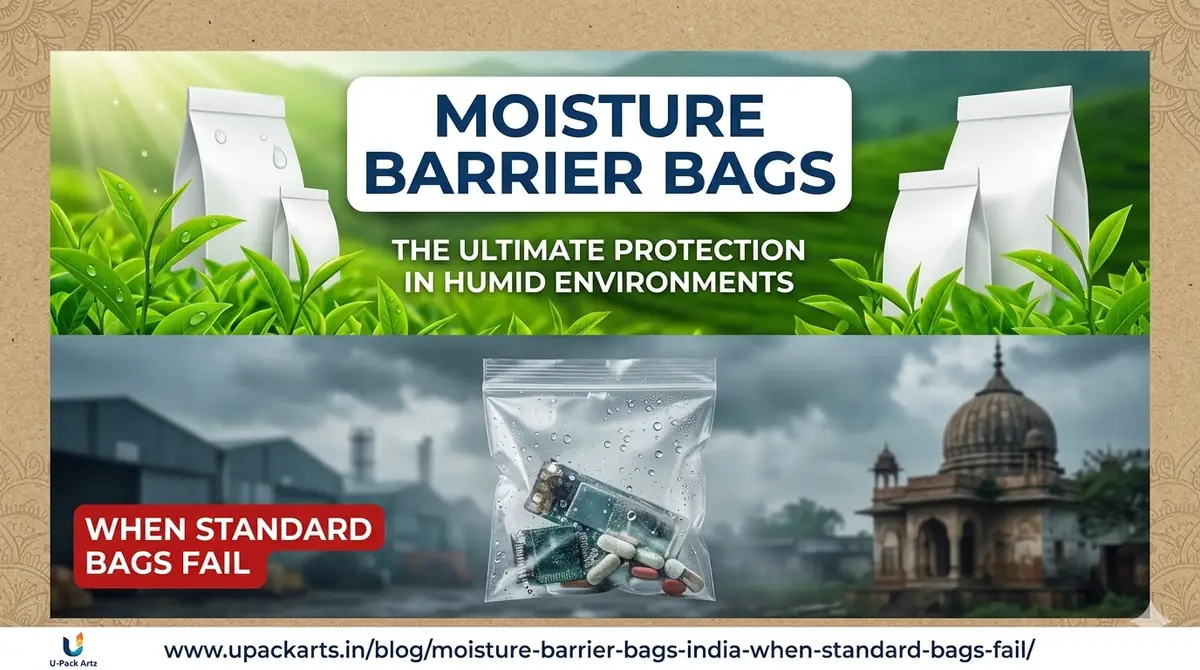
Moisture Barrier Bags India: When Standard Poly Bags Are Not Enough
Every year, Indian exporters and manufacturers lose significant value to moisture damage that standard poly bag packaging cannot prevent. The damage is silent and accumulates over weeks — appearing only when the shipment is opened at the destination, too late to be corrected.
---
Three Real Moisture Damage Scenarios
Scenario 1 — Electronic Components
A Pune electronics manufacturer sealed PCB sub-assemblies in standard 50 micron LDPE bags for a 35-day sea freight shipment to Germany. On arrival, 23 percent of assemblies failed functional test. Root cause: moisture ingress through the LDPE bags during ocean transit caused dendrite growth on fine-pitch pads, creating intermittent short circuits.
LDPE at 50 micron allows 10 to 15 g/m2/day moisture through. In 35 days of high-humidity sea freight conditions, significant moisture had accumulated inside each bag.
Fix: switched to aluminium foil MBBs with silica gel. Return rate dropped to under 1 percent.
Scenario 2 — Pharmaceutical API
A Mumbai API manufacturer shipped 25 kg batches of a hygroscopic API in HDPE-lined corrugated boxes. Batches stored in Chennai for 3 months before distribution showed moisture-related caking and assay values outside specification.
HDPE liner bags have WVTR of 5 to 8 g/m2/day. Insufficient for a hygroscopic API stored in the humid Chennai distribution environment.
Fix: heat-sealed aluminium foil bags with silica gel inside each HDPE bag. Product remained within specification for 12 months storage.
Scenario 3 — Precision Tooling
A Bengaluru precision tooling company stored high-value injection mould inserts in standard HDPE bags in their warehouse. After 8 months, rust spots appeared on critical machined surfaces requiring rework at Rs. 25,000 per insert.
Fix: VCI rust preventive paper wrapping inside vacuum-sealed aluminium foil bags. No corrosion after 24 months.
---
Understanding When MBBs Are Needed
The trigger conditions for using moisture barrier bags:
Storage or transit duration above 30 days in humid conditions (above 70% RH average).
Products with moisture sensitivity that causes irreversible damage — hygroscopic powders, moisture-sensitive electronics, pharmaceutical APIs.
Sea freight shipments — ocean transit exposes packaging to sustained high humidity and temperature cycling that drives moisture through standard poly bags.
MSL-rated electronic components — IPC/JEDEC J-STD-033 mandatory requirement.
Upackarts Aluminium Foil Moisture Barrier Bags: upackarts.in/products/aluminium-foil-moisture-barrier-bags/
Upackarts Moisture Barrier Bags MBB: upackarts.in/products/moisture-barrier-bags-mbb/
---
The Desiccant System
Moisture barrier bags work best as part of a system: the bag provides the primary barrier, desiccant provides secondary protection by absorbing any residual moisture inside the sealed package.
Silica gel: Rs. 2 to Rs. 15 per sachet. Absorbs 30 to 35 percent of own weight. For most industrial and pharmaceutical applications.
Clay desiccant: Rs. 1 to Rs. 8 per sachet. Lower cost, food-safe, better at temperatures below 20°C.
Upackarts Silica Gel Packets: upackarts.in/products/silica-gel-packets-packaging/
Upackarts Clay Desiccant Bags: upackarts.in/products/clay-desiccant-bags/
---
Cost Justification
Aluminium foil MBB: Rs. 8 to Rs. 85 per bag depending on size.
Silica gel sachets: Rs. 3 to Rs. 25 per bag.
Total moisture protection cost: Rs. 11 to Rs. 110 per unit.
Compare to: One electronics return (Rs. 3,800 product + Rs. 800 reverse logistics = Rs. 4,600). At 1 percent return rate on 100 units per month: Rs. 4,600 per month in avoidable returns.
Moisture protection at Rs. 50 per unit on 100 units per month: Rs. 5,000 per month.
For high-value electronics and pharmaceutical products: the break-even is at approximately 1 percent damage rate. Most operations exceeding this threshold see positive ROI on switching to MBBs within the first month.
---
Frequently Asked Questions
What is the difference between aluminium foil bags and standard poly bags for moisture protection?
Standard LDPE bags allow 8 to 15 g/m2/day of moisture through. Aluminium foil MBBs allow under 0.01 g/m2/day — 1,000x better barrier. For products requiring moisture protection over weeks or months, standard poly bags are insufficient. MBBs are required for any storage beyond 2 to 4 weeks in humid conditions.
Do I need humidity indicator cards with moisture barrier bags?
For MSL 4 to MSL 6 electronic components: yes, per IPC/JEDEC J-STD-033. For pharmaceutical and industrial applications: recommended for shipments over 30 days where you need verification that the barrier remained intact. If the HIC shows above the safe threshold on opening, the product needs evaluation before use.
Can moisture barrier bags prevent rust on machined metal parts?
MBBs prevent moisture from reaching the metal surface — yes, this prevents rust. For maximum protection, combine MBBs with VCI rust preventive paper (which actively inhibits corrosion) and silica gel desiccant (which absorbs residual moisture). This three-layer system provides corrosion-free storage for 2 to 5 years.
Need Packaging for Your Business in Pune?
Bulk corrugated boxes, wooden crates, and custom packaging at the best prices. Response in 30 minutes.
Related Articles
Get a Quick Quote
Tell us your requirement. Response in 30 minutes.
Request Quote WhatsApp Now- ✔ Reply in 30 minutes
- ✔ GST Invoice included
- ✔ Bulk pricing available
- ✔ Same-day dispatch, Pune