 Guide
Guide
How to Prevent Product Damage During Shipping in India: Complete Guide
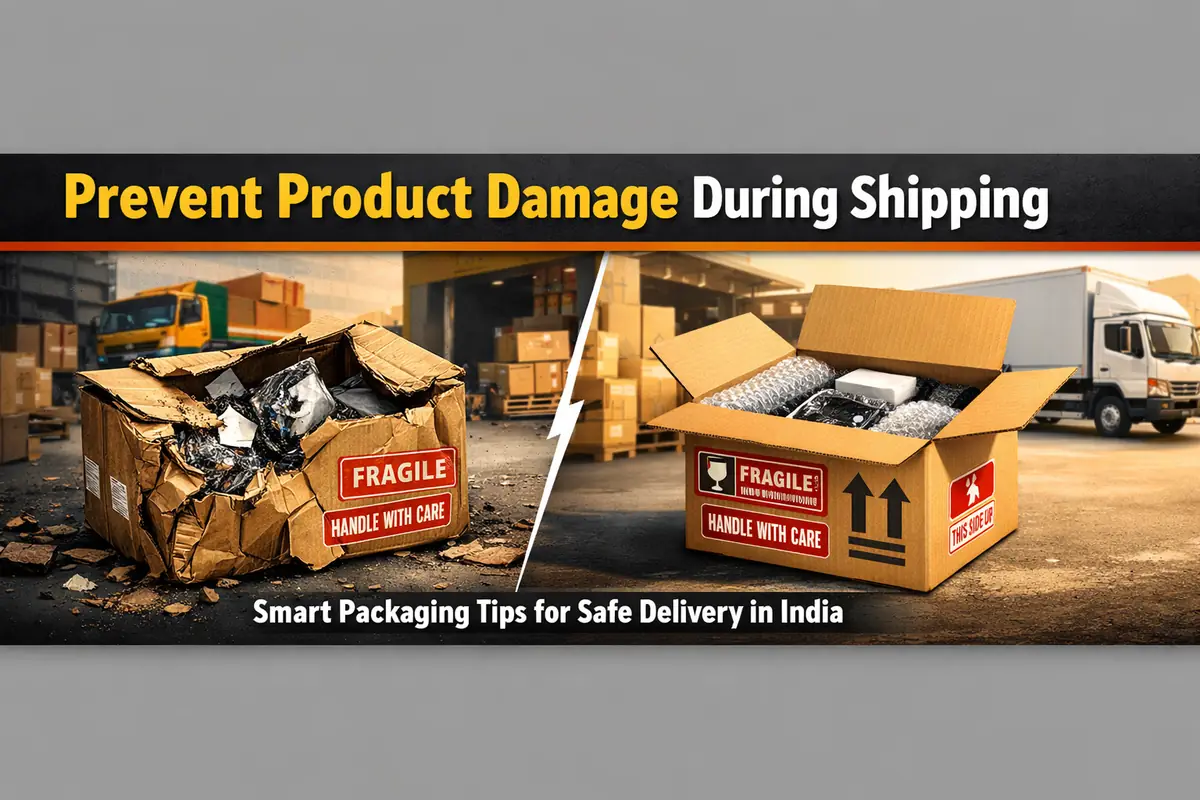
Every Indian business that ships products accepts some level of damage as normal. The question is: what is normal, and what is preventable?
A 5 to 8 percent damage rate is common in Indian e-commerce and industrial dispatch. A 0.5 to 1.5 percent damage rate is achievable with correct packaging. The gap between these two numbers — 4 to 7 percentage points — is entirely preventable and represents pure profit loss.
This guide identifies the root causes of each damage type and gives you the specific fix for each.
---
The 6 Root Causes of Shipping Damage in India
Root Cause 1 — Box Too Weak for the Weight
Symptom: Box arrives crushed, product inside crushed with it.
What happened: The 3-ply corrugated box rated for 5 kg carried a 8 kg product. Under the conveyor belt system at the courier hub, or under a stack of 4 similar boxes in the truck, the base of the bottom box compressed past its burst strength.
Fix: Match burst factor to product weight. Use 5-ply for anything above 3 kg on courier. Verify burst factor — not just ply count — when ordering boxes.
Root Cause 2 — Product Moving Inside the Box
Symptom: Product has impact marks, dents, or cracks on specific faces — the faces that were hitting the box wall.
What happened: The box was too large for the product and void fill was insufficient. During transit, the product travelled across the box interior and impacted the wall.
Fix: Right-size the box. Use correctly sized inner protection. Test by shaking the packed box — the product should not move at all.
Root Cause 3 — No Cushioning on Impact-Critical Surfaces
Symptom: Corners and edges damaged, flat surfaces intact.
What happened: Padding was placed on top and bottom but not on the sides. The product's corners contacted the corrugated side walls directly. Corners receive the highest impact loads in drops and conveyor handling.
Fix: Six-surface protection — foam or bubble wrap on all six interior box faces, not just top and bottom.
Root Cause 4 — Moisture Damage
Symptom: Product shows mould, corrosion, water damage, or label degradation — but no physical impact damage.
What happened: Moisture from condensation, rain exposure during loading, or ambient humidity entered the packaging and damaged the product over the transit period.
Fix: Inner HDPE poly bag moisture barrier. Silica gel desiccant inside sealed packaging. For metal components: VCI film.
Root Cause 5 — Pallet Toppling
Symptom: Multiple boxes from one pallet all damaged in the same way. Products from the same shipment all have damage on the same face.
What happened: The pallet load toppled during transit — either because it was not stretch-wrapped, not strapped, or improperly stacked (top-heavy, off-centre).
Fix: Correct pallet stacking (heavy base, light top). Stretch film wrapping minimum 3 layers. PP strapping with angle boards. Pallet height should not exceed 1.5 times the pallet base width.
Root Cause 6 — Box Not Sealed Correctly
Symptom: Box arrives open or partially open. Product exposed and damaged by contamination, impact, or water.
What happened: Single centre strip tape failed — either the adhesion was insufficient or the tape was applied to a dusty or damp box surface.
Fix: H-tape sealing method. Wipe box surfaces before taping if dusty. Use tape with adequate adhesion (minimum 450 g/25mm for standard industrial applications).
---
Building a Damage-Free Packaging System
The businesses with under 1 percent damage rates in India have not found a magic material. They have systematically eliminated each of the 6 root causes above.
Step 1: Audit your current damage. Track which products damage, at what rate, and what type of damage (crush, impact, moisture, exposure). This identifies which root cause to fix first.
Step 2: Fix the highest-frequency damage cause first. If 60 percent of your damages are crush damage (root cause 1), fix the box specification before addressing moisture or impact.
Step 3: Establish and document your packaging standard. Write down the exact specification for each product type — box size, ply count, inner protection, void fill, sealing method. Train every packer on the standard. Do not allow deviation.
Step 4: Monitor damage rate monthly. The rate should decrease each month as you eliminate root causes. If it stops decreasing, audit your packaging line — there is a root cause you have not addressed.
---
Documentation for Damage Claims
When damage occurs despite correct packaging:
Photograph the outside of the parcel before opening — showing the packaging condition as received.
Photograph the inside showing the packaging materials in place.
Photograph the damaged product.
Note the tracking number, dispatch date, delivery date, courier name.
This documentation supports insurance claims and courier damage claims. Without photographs, most claims are rejected.
---
Products from Upackarts
5-Ply Heavy Duty Corrugated Boxes: upackarts.in/products/5-ply-heavy-duty-corrugated-boxes/
Foam Sheets and Rolls: upackarts.in/products/foam-sheets-rolls/
Bubble Wrap Rolls: upackarts.in/products/bubble-wrap-rolls/
Silica Gel Packets: upackarts.in/products/silica-gel-packets-packaging/
BOPP Packing Tapes: upackarts.in/products/bopp-packing-tapes/
PP Straps and Clips: upackarts.in/products/pp-straps-clips/
Stretch Film: upackarts.in/products/stretch-film/
Angle Boards: upackarts.in/products/angle-boards/
Related guide: How to reduce transit damage in export shipments: upackarts.in/blog/reduce-transit-damage-export-shipments-packaging-strategies/
GST invoice. Delivery across India within 3 to 4 working days. WhatsApp +91-88560-64045.
---
Frequently Asked Questions
What is a normal damage rate for shipments in India?
For well-packaged shipments using correct box specification, inner protection, and sealing: under 1.5 percent is achievable. The industry average in Indian e-commerce and industrial dispatch is 5 to 8 percent — indicating most businesses have significant preventable damage.
How do I find out why my products are being damaged?
Track damage by product type and document the damage pattern (which surfaces are damaged, what type of damage). Crush damage indicates box strength issue. Impact marks on specific faces indicate movement inside the box. Moisture damage indicates no barrier or desiccant. Each pattern points to a specific root cause with a specific fix.
Can I claim compensation from courier companies for damaged shipments?
Yes, but only with documentation and within the terms of the courier's liability policy. Most Indian couriers limit liability to Rs. 2,000 to Rs. 5,000 per consignment unless additional declared value coverage is purchased. Always photograph packed shipments before dispatch and the received condition before opening.
Need Packaging for Your Business in Pune?
Bulk corrugated boxes, wooden crates, and custom packaging at the best prices. Response in 30 minutes.
Related Articles

Get a Quick Quote
Tell us your requirement. Response in 30 minutes.
Request Quote WhatsApp Now- ✔ Reply in 30 minutes
- ✔ GST Invoice included
- ✔ Bulk pricing available
- ✔ Same-day dispatch, Pune