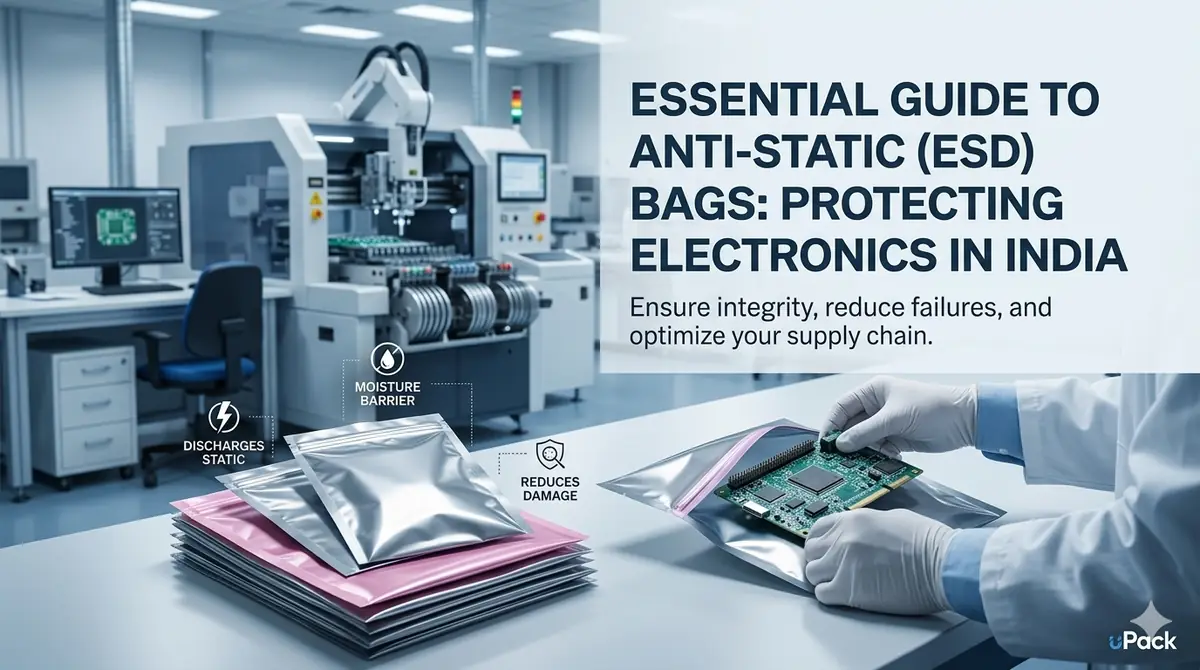
 Guide
Guide
Anti-Static ESD Bags India: Complete Guide for Electronics Manufacturers
ESD damage is the invisible killer of electronic components in transit. A component destroyed by electrostatic discharge shows no visible external damage — it appears functional but fails prematurely after deployment. The return rate is high, the root cause is hard to identify, and the cost per failure is disproportionate.
---
What ESD Damage Actually Looks Like in Practice
A Hinjewadi IoT sensor manufacturer was shipping 50 units per courier shipment at Rs. 3,800 per unit. Return rate was 11 percent with "device not functioning" complaints. On inspection, several units showed latent ESD damage to the main processor — invisible externally, fatal to function.
Fix: switched to anti-static bags for each sensor with 10mm anti-static foam sheet lining. Return rate dropped to under 0.5 percent.
Packaging cost increase: Rs. 22 per unit. Avoided return cost per unit: Rs. 3,800 plus reverse logistics.
This is the typical ESD packaging ROI calculation.
---
How ESD Damages Components
Standard plastic bags (clear LDPE or HDPE) generate static electricity through triboelectric charging — the charge that builds up when plastic surfaces rub against each other during handling. LDPE generates 500 to 5,000 volts of static charge in normal handling.
A static discharge of 25 volts can permanently damage a MOSFET transistor. Most ESD damage is latent — the component passes incoming inspection but fails early in service.
---
Anti-Static Bags (Pink) — Prevent Charge Generation
Anti-static bags contain an anti-static additive dispersed through the polyethylene matrix. The additive prevents triboelectric charging by providing a conductive path for static dissipation.
These bags prevent charge buildup from friction. They do NOT shield against external electric fields.
Use anti-static bags for: PCB sub-assemblies in transit between departments, connector and cable assemblies, consumer electronics accessories, moderately ESD-sensitive components (ESD sensitivity above 2,000 volts).
Upackarts Anti-Static Poly Bags: upackarts.in/products/anti-static-poly-bags/
---
Static Shielding Bags (Silver Metallic) — Block All Static Fields
Static shielding bags have a metallic layer (aluminium or nickel) that forms a Faraday cage around the contents. This blocks both internally generated static AND external electric fields.
These bags are required for: Bare semiconductor ICs, microprocessors, memory modules, RF components, and any MSL-rated component per IPC/JEDEC J-STD-033.
The test: can the contents be damaged by an external electrostatic field? If yes, use shielding bags, not anti-static bags.
---
Anti-Static Foam for the Inner Protection Layer
ESD protection requires not just the outer bag but also the inner cushioning material. Standard EPE foam and bubble wrap generate static electricity. Anti-static foam (pink EPE) has the same anti-static additive as anti-static bags.
Never use standard foam in direct contact with ESD-sensitive components. Always use anti-static foam or ESD foam.
Upackarts Foam Sheets and Rolls: upackarts.in/products/foam-sheets-rolls/ (ask for anti-static specification — WhatsApp +91-88560-64045)
---
MSL-Rated Component Packaging
Moisture Sensitive Level (MSL) ratings from IPC/JEDEC J-STD-033 specify the floor life of moisture-sensitive semiconductor components at 30°C / 60% RH:
MSL 1: Unlimited floor life. No dry packing required.
MSL 2 to 3: Dry pack in MBB with desiccant required when storage exceeds floor life.
MSL 4 to 6: Dry pack in aluminium foil MBB with desiccant and humidity indicator card mandatory.
Standard anti-static bags do not meet MBB moisture barrier requirements for MSL-rated components. Use aluminium foil moisture barrier bags with anti-static inner PE layer.
Upackarts Moisture Barrier Bags MBB: upackarts.in/products/moisture-barrier-bags-mbb/
Upackarts Aluminium Foil Moisture Barrier Bags: upackarts.in/products/aluminium-foil-moisture-barrier-bags/
Upackarts Humidity Indicator Cards: upackarts.in/products/humidity-indicator-cards/
---
Frequently Asked Questions
What is the difference between anti-static and static shielding bags?
Anti-static bags (pink polyethylene) prevent static charge generation by friction — they do not block external electric fields. Static shielding bags (metallic silver) form a Faraday cage that blocks all static fields — both internal and external. Use anti-static for moderately sensitive components; use shielding bags for bare ICs, processors, and MSL-rated components.
Do I need special packaging for components with ESD sensitivity above 1,000 volts?
Components with ESD sensitivity above 2,000 volts (most standard logic ICs and microcontrollers): anti-static bags provide sufficient protection. For components with ESD sensitivity below 2,000 volts (MOSFETs, RF transistors, most memory): static shielding bags are required.
How long do anti-static bags remain effective?
The anti-static additive in poly bags gradually migrates to the surface and depletes over time. Most anti-static bags are rated for 2 to 3 years from manufacture. Do not use anti-static bags older than 3 years for critical ESD-sensitive components — the additive may be depleted and the bag will generate static like a standard poly bag.
Need Packaging for Your Business in Pune?
Bulk corrugated boxes, wooden crates, and custom packaging at the best prices. Response in 30 minutes.
Related Articles



Get a Quick Quote
Tell us your requirement. Response in 30 minutes.
Request Quote WhatsApp Now- ✔ Reply in 30 minutes
- ✔ GST Invoice included
- ✔ Bulk pricing available
- ✔ Same-day dispatch, Pune