 Export
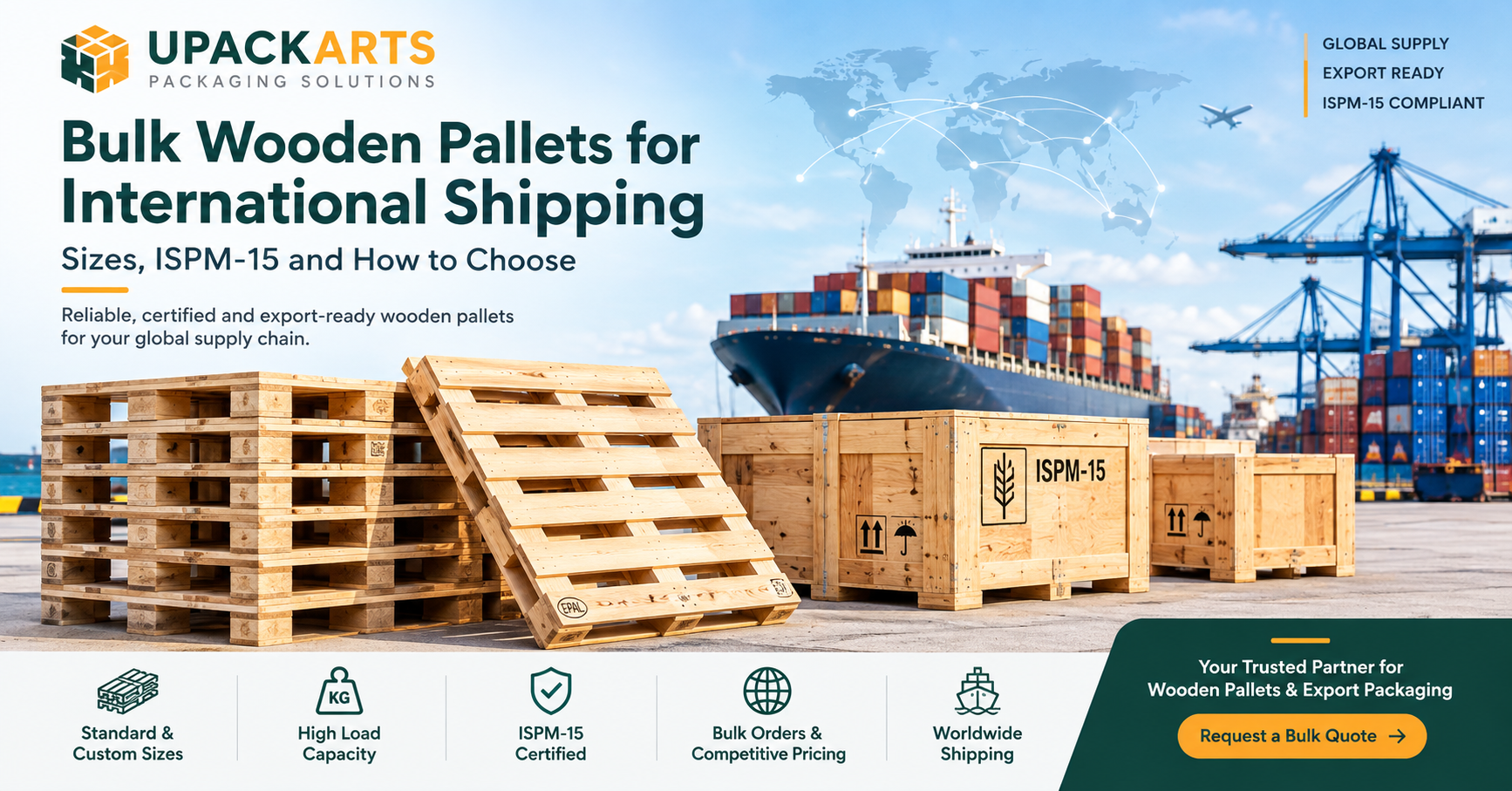
Bulk Wooden Pallets for International Shipping: Sizes, ISPM-15 and How to Choose
Introduction
When a company ships products internationally, the wooden pallet underneath the cargo is more than a simple platform for handling goods. The pallet has to support the shipment, work with forklifts and pallet trucks, fit the available loading space and, where applicable, meet phytosanitary requirements for international trade.
For businesses purchasing pallets in large quantities, selecting the right supplier is therefore an important procurement decision.
A shipment may require hundreds or thousands of pallets with consistent dimensions, suitable load capacity, appropriate timber construction and documented treatment. For export shipments, the buyer may also need wood packaging material that complies with the requirements applicable in the destination market.
This guide explains what businesses should consider when sourcing bulk wooden pallets for international shipping, including pallet sizes, construction, load capacity, ISPM-15 treatment, custom specifications and supplier selection.
If you are purchasing wooden pallets for manufacturing, warehousing, export shipments or industrial logistics, the objective should not simply be to find the lowest price per pallet. The right pallet specification can reduce handling problems, improve container utilization and make large-scale procurement more predictable.
What Are Bulk Wooden Pallets?
Bulk wooden pallets are pallets purchased in quantities intended for commercial, industrial, warehousing or logistics operations rather than occasional individual use.
Businesses may purchase pallets in bulk for:
* Export shipments
* Manufacturing plants
* Distribution centres
* Warehouses
* Automotive components
* Engineering products
* Machinery and equipment
* Electrical equipment
* Industrial components
* Consumer goods distribution
* Third-party logistics operations
Bulk purchasing allows companies to standardize pallet dimensions and construction across repeated shipments.
For example, an exporter may require the same pallet specification every month for shipments going to customers in different countries. Instead of purchasing different pallets for every shipment, the company can establish a standard specification covering dimensions, load requirements, timber construction and treatment.
This is particularly useful when pallet requirements are part of a regular supply chain rather than a one-time shipment.
Why Pallet Specification Matters for International Shipping
A wooden pallet supports the cargo throughout several stages of transportation.
The shipment may be:
1. Loaded at the manufacturing facility
2. Moved by forklift or pallet truck
3. Stored temporarily in a warehouse
4. Loaded into a truck or container
5. Transported to a port
6. Handled during the logistics process
7. Unloaded at the destination
8. Moved through another warehouse or distribution centre
The pallet therefore needs to remain structurally suitable throughout the handling cycle.
A pallet that is appropriate for a light domestic load may not be appropriate for a heavy industrial shipment. Similarly, a pallet dimension that works well inside a warehouse may not provide the best utilization of a particular container or trailer.
For bulk procurement, businesses should define the pallet specification before requesting quotations.
Common Wooden Pallet Sizes
There is no single wooden pallet size suitable for every business.
Common specifications include 1200 × 1000 mm and 1200 × 800 mm, while many industrial users require custom dimensions based on their products and handling systems.
The right size depends on factors such as:
* Product dimensions
* Product weight
* Forklift entry requirements
* Pallet rack dimensions
* Truck or container loading
* Warehouse layout
* Stacking requirements
* Destination market
* Existing supply-chain standards
1200 × 800 mm Pallets
The 1200 × 800 mm format is commonly associated with Euro-pallet dimensions and can be suitable for businesses operating around European logistics standards.
However, companies should not assume that every 1200 × 800 mm pallet is automatically a Euro pallet. Construction, specifications, certification and intended use can differ.
If a buyer specifically requires a certified Euro pallet rather than simply a pallet measuring 1200 × 800 mm, the exact requirement should be stated during procurement.
1200 × 1000 mm Pallets
The 1200 × 1000 mm format is another widely used industrial pallet dimension.
It can provide a practical platform for many manufacturing and export applications and may be suitable for products that require more surface area than an 800 mm-wide pallet provides.
Custom Wooden Pallets
Many industrial shipments cannot use standard pallet dimensions efficiently.
Custom pallets can be designed around:
* Product dimensions
* Centre of gravity
* Load distribution
* Forklift access
* Lifting equipment
* Container dimensions
* Stacking requirements
* Product overhang limitations
For large recurring orders, a custom pallet specification can be more useful than forcing a product onto an unsuitable standard pallet.
2-Way vs 4-Way Entry Pallets
Pallet entry refers to the directions from which material-handling equipment can access the pallet.
A 2-way pallet generally permits fork entry from two opposing directions.
A 4-way entry pallet is designed to permit access from all four sides, subject to the pallet's actual construction and handling equipment.
For industrial supply chains, 4-way entry can provide greater flexibility during warehouse and loading operations.
However, entry configuration should be selected based on the equipment being used rather than simply choosing the option that sounds more versatile.
Before ordering in bulk, buyers should confirm:
* Forklift type
* Pallet truck compatibility
* Fork dimensions
* Entry height
* Warehouse handling system
* Rack requirements
How Much Weight Can a Wooden Pallet Hold?
There is no universal load capacity for every wooden pallet.
Actual capacity depends on the pallet design, timber, board dimensions, stringer or block construction, fasteners, support conditions and whether the load is static, dynamic or racked.
A pallet supplier should therefore avoid giving a single generic load figure without understanding the application.
For a bulk order, the buyer should provide information such as:
* Product weight per pallet
* Dimensions of the load
* Load distribution
* Whether the pallet will be moved by forklift
* Whether pallets will be stacked
* Whether the pallet will be stored in a rack
* Expected handling frequency
A pallet designed for a uniformly distributed industrial load may perform differently from the same pallet carrying a concentrated heavy component.
This is particularly important for machinery, engineering components and other high-density products.
What Is ISPM-15?
ISPM-15 is an international phytosanitary standard concerning wood packaging material used in international trade.
The International Plant Protection Convention describes ISPM-15 as a standard intended to reduce the risk of introduction and spread of quarantine pests associated with the movement of raw-wood packaging material in international trade.
Wood packaging covered by the standard can include pallets, crates, dunnage and similar packaging materials.
This is one reason export buyers frequently specify ISPM-15 compliant wooden pallets and crates.
The exact import requirements and enforcement procedures can vary by country, so exporters and importers should always verify the current requirements applicable to their shipment and destination.
What Does Heat Treatment Mean for Wooden Pallets?
One approved ISPM-15 treatment is heat treatment.
Under the conventional heat-treatment schedule described in ISPM-15, wood must reach a minimum temperature of 56°C for a minimum of 30 continuous minutes throughout the wood profile, including the core.
The treatment is intended to manage phytosanitary risks associated with regulated wood packaging material.
The important point for buyers is that simply purchasing a kiln-dried-looking pallet should not be treated as equivalent to compliant ISPM-15 treatment.
When pallets are required for international trade, buyers should discuss the applicable treatment, marking and documentation requirements with the supplier before placing the order.
Why the ISPM-15 Mark Matters
The ISPM-15 mark is used on compliant wood packaging material to indicate relevant treatment and other identifying information under the standard.
For exporters, the marking is an important part of the wood-packaging compliance process.
However, a printed or stamped mark by itself should not be treated as the only supplier-verification step.
For bulk procurement, buyers should also confirm:
* Who performed the treatment
* Whether the treatment provider is appropriately authorized
* What treatment was applied
* Whether supporting documentation is available
* Whether the pallets meet the requirements of the destination country
* Whether the marking corresponds to the applicable requirements
The IPPC also provides implementation guidance covering treatment, marking, manufacture, repair, reuse and responses to non-compliance.
Should You Buy Standard or Custom Wooden Pallets?
The answer depends on your supply chain.
Standard pallets can be suitable when:
* Your products fit the pallet dimensions
* Your warehouse already uses a standard size
* Your handling equipment is compatible
* Your customers accept the specification
* Your shipments are repetitive
Custom pallets can make more sense when:
* Your product has unusual dimensions
* The load is extremely heavy
* The product requires special support
* You need specific forklift entry
* Container utilization is important
* The pallet must integrate with custom export packaging
For bulk orders, custom design should be considered before production begins.
Changing the pallet specification after a large production run can be more expensive than defining the correct requirements at the beginning.
Wooden Pallets for Container Shipping
Container loading is one of the most important considerations for exporters purchasing pallets.
A pallet should be selected not only according to the product but also according to the available loading space.
The buyer should consider:
* Internal container dimensions
* Pallet footprint
* Cargo dimensions
* Number of pallets per container
* Product height
* Stacking possibilities
* Loading and unloading method
* Weight distribution
A small difference in pallet dimensions can affect how cargo is arranged inside a container.
For high-volume exporters, pallet dimensions should therefore be considered together with the complete loading plan rather than independently.
What Should You Tell a Wooden Pallet Supplier?
A supplier can provide a more accurate quotation when the buyer gives a complete specification.
For a bulk wooden pallet requirement, provide:
**1. Pallet dimensions**
Example:
1200 × 1000 mm
**2. Quantity**
Example:
500, 1,000 or 5,000 pallets
**3. Load requirement**
State the approximate weight per pallet and, where relevant, whether the load is static, dynamic or racked.
**4. Entry requirement**
2-way or 4-way, depending on the handling equipment.
**5. Timber requirements**
Specify any required timber species, board thickness or construction requirements where applicable.
**6. Treatment**
State whether ISPM-15 treatment is required.
**7. Destination**
Provide the delivery country and, where possible, the destination city or port.
**8. Application**
Explain whether the pallets are intended for export, warehousing, machinery, automotive components, engineering goods or another application.
**9. Delivery schedule**
For large orders, production and delivery timelines should be agreed before purchase.
The more complete the specification, the easier it becomes for the supplier to provide a meaningful quotation.
How to Choose a Bulk Wooden Pallet Supplier
Price is important, but it should not be the only consideration for large-volume procurement.
A business sourcing thousands of pallets should evaluate the supplier's ability to consistently manufacture or supply the required specification.
Consider asking:
Can the supplier provide consistent dimensions?
Large orders require consistency across batches.
Can the supplier handle recurring quantities?
A supplier suitable for a small local order may not necessarily be equipped for a recurring industrial requirement.
Can the supplier provide custom sizes?
This matters when the pallet must match a particular product or loading configuration.
Can the supplier support export requirements?
If the pallets are being used for international shipments, discuss ISPM-15 treatment, marking and relevant documentation before ordering.
Can the supplier provide samples?
For a new supplier, a sample or trial batch can help verify dimensions, construction and handling compatibility before committing to a larger order.
Can the supplier support your delivery schedule?
For manufacturing and export operations, late pallet delivery can affect the shipment itself.
A reliable bulk supplier should therefore be evaluated on quality consistency, communication, production capacity, documentation and delivery capability as well as price.
Bulk Wooden Pallets from India
India has a large manufacturing and export base, creating demand for industrial wooden pallets and export packaging.
For international buyers sourcing from India, the procurement process should be based on the actual specification and destination requirement rather than simply comparing a per-piece price.
Upackarts Packaging Solutions supplies wooden pallets for industrial and export applications, including custom sizes and bulk requirements.
For buyers planning recurring pallet purchases, specifications can be discussed based on:
* Required dimensions
* Quantity
* Load capacity
* Entry configuration
* ISPM-15 requirement
* Delivery destination
* Application
For international orders, buyers should confirm the applicable import requirements in their destination country before placing an order.
How Much Do Bulk Wooden Pallets Cost?
There is no single international price for a wooden pallet.
The price can vary significantly depending on:
* Dimensions
* Timber type
* Timber thickness
* Pallet construction
* Load capacity
* 2-way or 4-way entry
* ISPM-15 treatment
* Quantity
* Customization
* Packaging
* Transport distance
* Delivery location
* Current timber costs
A buyer requesting a quotation should therefore provide the complete pallet specification instead of asking only for a generic "wooden pallet price."
For large quantities, suppliers may also structure pricing differently depending on the total order volume and delivery requirements.
When Should You Order Wooden Pallets in Bulk?
Bulk procurement is particularly useful when pallet demand is predictable.
Businesses may benefit from planned procurement when they:
* Ship products regularly
* Operate multiple warehouses
* Export every month
* Have recurring customer orders
* Need consistent pallet specifications
* Want to avoid last-minute procurement
* Require custom pallet designs
For recurring export shipments, maintaining a defined pallet specification can simplify purchasing and reduce the risk of receiving incompatible pallets.
Bulk Wooden Pallets: Procurement Checklist
Before confirming a large order, review the following checklist:
* [ ] Confirm pallet dimensions
* [ ] Confirm 2-way or 4-way entry
* [ ] Confirm product weight
* [ ] Confirm load type
* [ ] Confirm stacking requirements
* [ ] Confirm warehouse/racking requirements
* [ ] Confirm ISPM-15 requirement
* [ ] Confirm destination-country requirements
* [ ] Confirm treatment and marking
* [ ] Request supporting documentation where applicable
* [ ] Confirm sample or trial quantity if required
* [ ] Confirm total quantity
* [ ] Confirm production timeline
* [ ] Confirm delivery location
* [ ] Confirm quotation validity
* [ ] Confirm payment terms
This approach helps procurement teams compare suppliers on the complete specification rather than only the headline price.
Frequently Asked Questions
Are ISPM-15 pallets required for international shipping?
Wood packaging material made from raw wood can be subject to ISPM-15 requirements when used in international trade. The exact requirements and enforcement procedures depend on the countries involved, so exporters should verify the current requirements applicable to their shipment.
What is the most common wooden pallet size?
There is no single universal size. 1200 × 1000 mm and 1200 × 800 mm are widely used pallet dimensions, but industrial buyers may require custom dimensions depending on their products, warehouses and transportation systems.
Can wooden pallets be custom-made in bulk?
Yes. Industrial suppliers can produce custom wooden pallets based on dimensions, load requirements, entry configuration and application. Custom specifications should be finalized before production, particularly for large orders.
How do I order wooden pallets in bulk?
Provide the supplier with the pallet dimensions, quantity, load requirement, entry configuration, intended application, treatment requirements and delivery destination. This allows the supplier to prepare a more accurate quotation.
Can Upackarts supply wooden pallets for export?
Upackarts Packaging Solutions supplies wooden pallets for industrial and export applications, including bulk orders and custom sizes. International buyers should provide the required specification, quantity, destination and applicable treatment requirements so the order can be evaluated correctly.
Request a Bulk Wooden Pallet Quote
Looking for wooden pallets for a recurring manufacturing, warehousing or export requirement?
Upackarts can discuss bulk wooden pallet requirements based on your dimensions, quantity, load capacity, application and delivery destination.
When requesting a quotation, share:
**Quantity + Dimensions + Load Requirement + Destination + ISPM-15 Requirement**
This allows the requirement to be evaluated more accurately and helps avoid delays caused by incomplete specifications.
For bulk wooden pallet requirements, contact Upackarts Packaging Solutions to discuss your application and receive a quotation based on your required specification.
Need Packaging for Your Business in Pune?
Bulk corrugated boxes, wooden crates, and custom packaging at the best prices. Response in 30 minutes.
Related Articles

Get a Quick Quote
Tell us your requirement. Response in 30 minutes.
Request Quote WhatsApp Now- ✔ Reply in 30 minutes
- ✔ GST Invoice included
- ✔ Bulk pricing available
- ✔ Same-day dispatch, Pune