 Guide
Guide
Container Loading India: How to Secure Cargo for Sea Freight
Improperly secured cargo in shipping containers is one of the most expensive problems in Indian export packaging. A container that shifts during a 25 to 35 day ocean voyage can arrive with crushed pallets, broken product, and damaged packaging — all of which is unrecoverable after the container is loaded at the Indian port.
This guide covers the key cargo securing methods for 20-foot and 40-foot container stuffing at Indian ports and ICDs.
---
The Physics of Ocean Container Movement
A 20-foot container at sea experiences three types of motion:
Roll: Side-to-side rotation. The highest amplitude motion — up to 30 degrees in rough seas. Creates lateral forces on cargo.
Pitch: Front-to-back rotation. Creates fore-aft forces on cargo.
Heave: Vertical motion. Creates vertical forces — cargo can momentarily become weightless and then impact the floor.
In rough seas, lateral g-forces on cargo can reach 0.8g — 80 percent of gravity. A 1,000 kg pallet load can experience lateral forces of 800 kg. Any cargo not secured against these forces will move.
---
Pallet Loading Principles
Column stacking: Stack boxes in column alignment (corners over corners). Interlocked stacking is for stability in warehouses — in containers, column stacking provides better compressive load transfer.
Weight distribution: Heaviest pallets against the container floor, lighter pallets stacked. Even weight distribution fore and aft — avoid loading all heavy cargo at the door end.
No movement: The cargo must not move when the container doors are closed and the container is tilted. Test by pushing loaded pallets from the side — they should not shift.
---
Dunnage Air Bags — Filling the Gaps
When pallets do not fill the container completely (which is almost always the case), the remaining gaps between pallets and between the last pallet row and the container door are the movement zones.
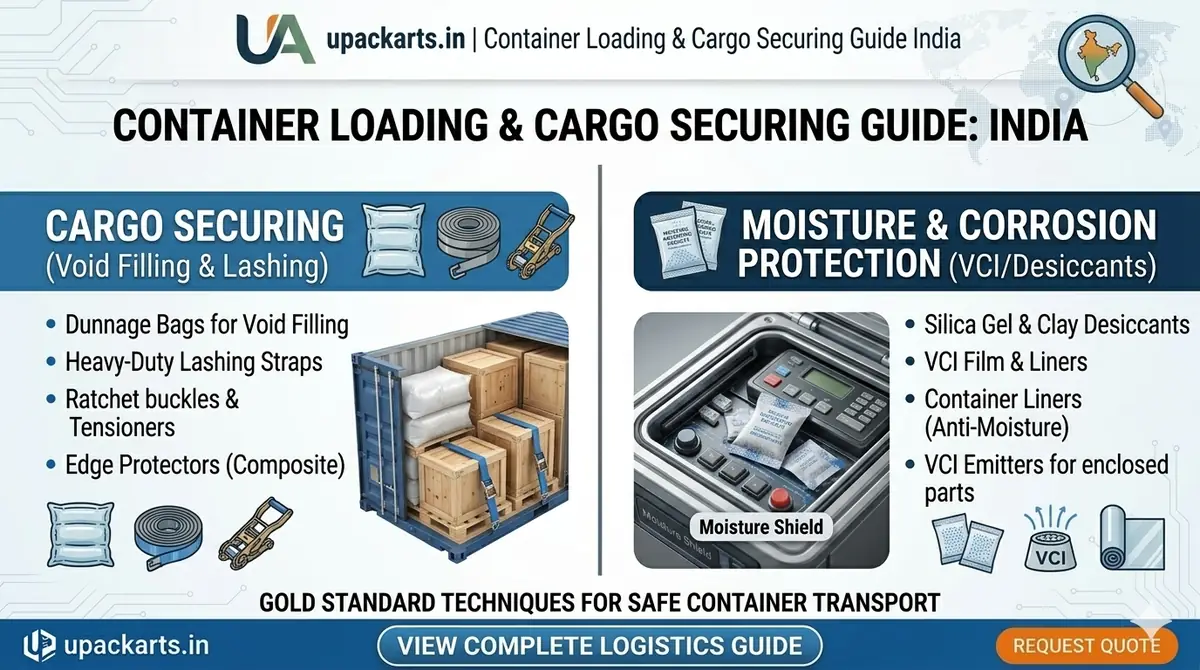
Dunnage air bags fill these gaps. Inflate a woven polypropylene or kraft paper dunnage bag with compressed air (30 to 60 seconds per bag) until it fills the gap firmly. The inflated bag prevents the pallets from sliding into the void.
Container placement:
Gaps between pallet rows: One bag per gap, inflated to fill 100 to 450mm gaps.
Container door gap: One or two bags between the last pallet row and the container doors.
Side gaps: Where pallets do not reach the container walls.
Upackarts Dunnage Air Bags: upackarts.in/products/dunnage-air-bags/
---
Lashing Straps — Restraint for Heavy Loads
For heavy cargo, dunnage air bags must be supplemented with ratchet lashing straps running from the cargo to the container floor D-ring lashing points.
Standard container floor lashing D-rings have a load rating of 2,000 to 2,500 kg each. For a 1,000 kg pallet: two lashing straps at 45-degree angles from the pallet top corners to the floor D-rings provide restraint in all directions.
Lashing strap positioning:
Over-the-top: Strap goes over the top of the pallet load and down to floor D-rings on each side. Prevents toppling.
Fore-aft: Straps running from pallet front face to floor D-rings behind prevent forward sliding under pitch motion.
Upackarts Ratchet Lashing Straps: upackarts.in/products/ratchet-lashing-straps/
---
Pallet Top Caps and Corner Protection
During loading with forklifts at the port, the top corners of pallets are vulnerable to impact from forklift tines and container walls. Corrugated pallet top caps placed on the uppermost layer and foam or corrugated angle boards on the four corners protect the top layer of boxes during port loading and transit.
Upackarts Pallet Top Caps and Frames: upackarts.in/products/pallet-top-caps-frames/
Upackarts Angle Boards: upackarts.in/products/angle-boards/
---
Frequently Asked Questions
How many dunnage air bags does a 20-foot container need?
A 20-foot container typically uses 4 to 8 dunnage air bags depending on the number of gaps. Each bag fills one gap of 100 to 450mm width. Calculate the gaps in your container loading plan — typically one gap between each pallet row and one at the container door.
What AAR level dunnage air bag should I use for Indian sea freight exports?
Level 3 (10 psi) woven polypropylene dunnage bags are the standard for most Indian industrial export container loading. Level 2 is sufficient for road freight. Level 4 and 5 for very heavy loads above 2,000 kg per pallet.
Can I use cardboard blocking instead of dunnage air bags?
Corrugated layer pads stacked as blocking are less effective than dunnage air bags because they do not fill gaps completely and compress progressively under load. Dunnage air bags maintain their pressure and fill gaps completely. For compliant cargo securing per IMO cargo securing requirements: dunnage air bags are the accepted standard; cardboard blocking is supplementary.
Need Packaging for Your Business in Pune?
Bulk corrugated boxes, wooden crates, and custom packaging at the best prices. Response in 30 minutes.
Related Articles

Get a Quick Quote
Tell us your requirement. Response in 30 minutes.
Request Quote WhatsApp Now- ✔ Reply in 30 minutes
- ✔ GST Invoice included
- ✔ Bulk pricing available
- ✔ Same-day dispatch, Pune