 Guide
Guide
Dunnage Air Bags India: When and How to Use Them in Containers and Trucks
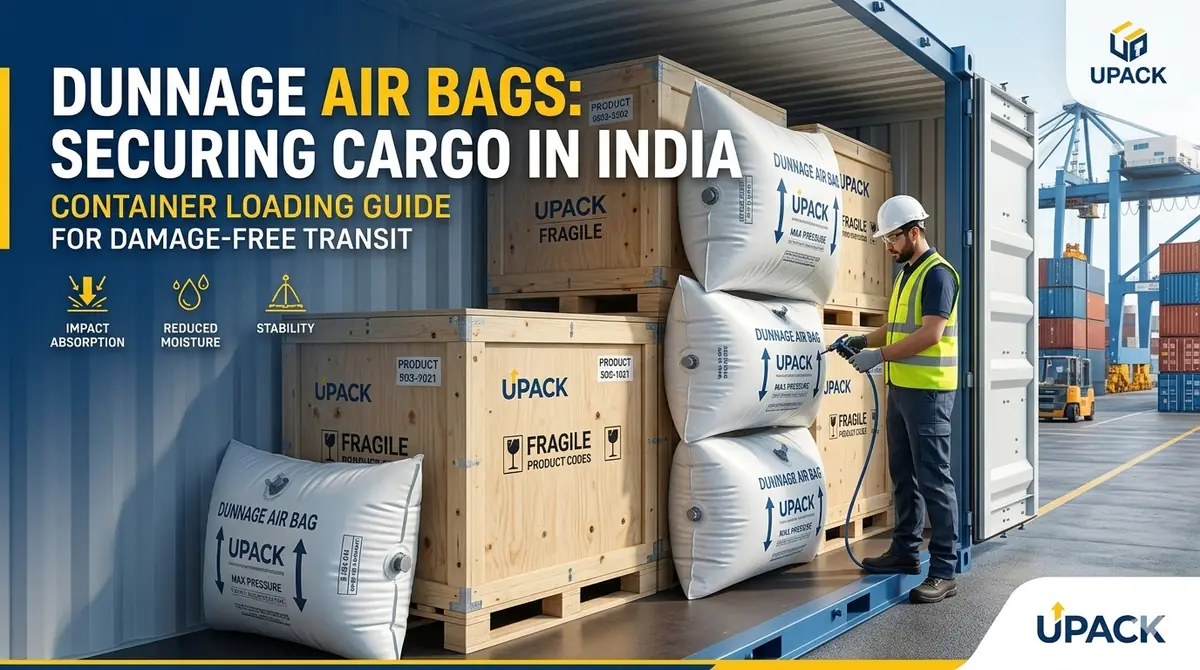
Dunnage air bags are the most practical solution to the gap problem in container and truck loading. Cargo never fills a vehicle exactly. The gaps between pallets, between the last pallet row and vehicle walls or doors, are where cargo moves during transit.
Every movement in transit is a potential damage event.
---
What Dunnage Air Bags Do
Dunnage air bags fill void spaces between cargo loads. An uninflated bag weighing under 1 kg is placed in the gap and inflated with compressed air in 30 to 60 seconds. The inflated bag provides a cushioned compressive force against the adjacent cargo faces, preventing lateral movement.
Traditional dunnage methods — timber planks, cardboard blocking — are heavy, generate waste, require tools, and cannot fill irregular gaps. Dunnage air bags are lightweight, tool-free, and fill gaps of any shape.
---
AAR Certification Levels Explained
The Association of American Railroads (AAR) certification system rates dunnage bags by the pressure and force they provide:
Level 1 (5 psi working pressure): For light loads in road freight, gaps under 150mm.
Level 2 (7.5 psi): For medium loads in road freight and short rail.
Level 3 (10 psi): The standard for most Indian industrial sea freight container loading.
Level 4 (12 psi): For heavy industrial loads above 2,000 kg per pallet.
Level 5 (14.5 psi): Maximum rating — for the heaviest loads and widest gaps up to 450mm.
For most Indian manufacturers exporting standard palletised cargo: Level 3 woven PP bags are the correct specification.
Upackarts Dunnage Air Bags: upackarts.in/products/dunnage-air-bags/
---
Woven PP vs Kraft Paper Bags
Woven polypropylene dunnage bags: More durable, resists puncture from protruding strapping and pallet corners. Reusable 3 to 5 times if deflated and stored correctly. For regular exporters: lower per-use cost over time.
Kraft paper dunnage bags (multi-wall kraft): Single use. Lower purchase cost per bag. For infrequent exporters or where reuse is not practical.
---
Correct Placement in 20-Foot Containers
Step 1 — Load pallets and assess gaps: After loading all pallets, identify all gaps over 100mm — between pallet rows, between pallets and container walls, between the last row and container doors.
Step 2 — Place uninflated bags: Insert the uninflated bag horizontally into the gap at mid-height of the pallet load. If the gap is taller than the bag diameter when inflated, use two bags stacked vertically.
Step 3 — Inflate: Connect compressed air line to the inflation valve. Inflate to the rated pressure (check the bag label for correct PSI). The bag expands to fill the gap and presses against adjacent cargo faces.
Step 4 — Check tension: After inflation, push each adjacent pallet face. The cargo should not shift. If it moves, add a second bag or check inflation pressure.
Step 5 — Document: Note the number and placement of dunnage bags in the Container Loading Report for insurance and cargo claim purposes.
---
Correct Placement in Trucks
For open-body trucks carrying palletised cargo: dunnage air bags fill the fore-aft gaps between pallet loads and the truck body front panel, preventing cargo from sliding forward under braking.
Combined with ratchet lashing straps for side-to-side restraint, this provides complete cargo securing for road freight.
Upackarts Ratchet Lashing Straps: upackarts.in/products/ratchet-lashing-straps/
---
Frequently Asked Questions
How do I inflate dunnage air bags without a compressor?
Woven PP dunnage bags require a compressed air supply — a workshop air compressor at 6 to 8 bar is standard. For port and ICD container stuffing where a compressor is available, this is not an issue. For warehouse pre-stuffing without a compressor: use a high-volume electric pump (inflates more slowly but achieves the required pressure).
Can dunnage air bags be reused?
Woven PP dunnage bags can be reused 3 to 5 times if: deflated carefully after use (open the inflation valve fully, press out remaining air, fold and store flat), inspected for punctures or tears before reuse, and inflated to the correct pressure each time. Bags with any visible damage should be discarded.
What gap size requires a dunnage air bag?
Any gap over 100mm between cargo loads in a container or truck requires filling. Gaps under 100mm are generally acceptable for domestic road freight. For sea freight, fill all gaps over 50mm — ocean transit motion amplitudes are higher than road freight.
Need Packaging for Your Business in Pune?
Bulk corrugated boxes, wooden crates, and custom packaging at the best prices. Response in 30 minutes.
Related Articles
Get a Quick Quote
Tell us your requirement. Response in 30 minutes.
Request Quote WhatsApp Now- ✔ Reply in 30 minutes
- ✔ GST Invoice included
- ✔ Bulk pricing available
- ✔ Same-day dispatch, Pune