 Guide
Guide
Honeycomb Paper vs Bubble Wrap India: Which is Better for D2C Brands
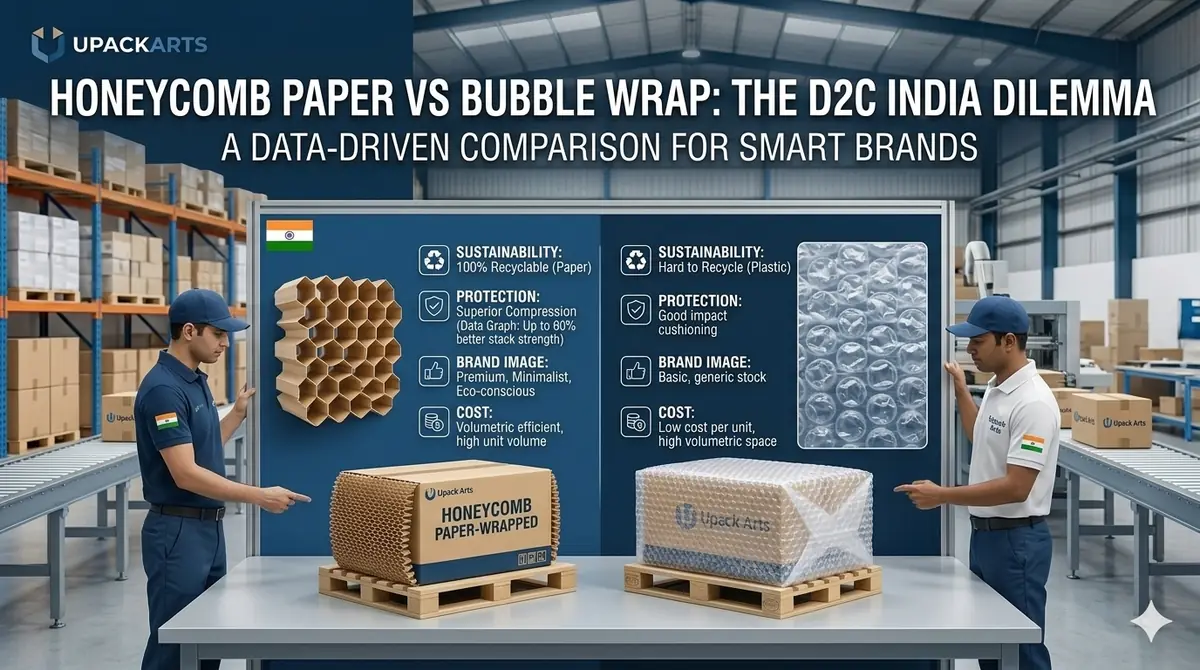
The switch from bubble wrap to honeycomb paper is the most common packaging change among Indian D2C brands in 2025 and 2026. Before making the switch, it is worth understanding exactly where honeycomb paper performs equally, where it outperforms, and where bubble wrap still has an advantage.
---
Side-by-Side Protection Comparison
Cushioning depth per layer: Standard bubble wrap (10mm bubble) provides 10 to 15mm of effective cushioning. Expanded honeycomb paper provides 20 to 30mm per layer.
Energy absorption: Bubble wrap absorbs impact through air cell compression — linear and predictable. Honeycomb absorbs through cell wall bending deformation — provides slightly less energy absorption per mm at equivalent thickness.
Net protection for products under 5 kg: Equivalent. Multiple honeycomb studies show comparable or slightly better protection vs bubble wrap for standard D2C product weights and typical courier drop heights (50 to 100cm).
For products above 5 kg or with sharp edges: Bubble wrap slightly outperforms honeycomb for impact protection.
---
Cost Per Shipment Comparison
Standard bubble wrap (300mm wide, 100m roll, Rs. 450):
Standard D2C shipment uses approximately 1 to 1.5m of wrap.
Cost per shipment: Rs. 4.50 to Rs. 6.75.
Honeycomb paper roll (300mm, 30m roll, Rs. 390):
Standard D2C shipment uses approximately 0.5 to 0.8m (expanded).
Cost per shipment: Rs. 6.50 to Rs. 10.40.
Honeycomb is 30 to 50 percent more expensive per shipment. The premium is real.
Where the economics shift: For EU export customers requiring recyclable packaging — where compliance documentation for plastic packaging adds an indirect cost. And for brands where customer perception of sustainable packaging drives measurably higher retention.
Upackarts Honeycomb Kraft Paper Wrap: upackarts.in/products/honeycomb-kraft-paper-wrap/
Upackarts Bubble Wrap Rolls: upackarts.in/products/bubble-wrap-rolls/
---
Customer Perception — The D2C Factor
In consumer research on unboxing experience, honeycomb paper consistently scores higher than bubble wrap on "premium feel", "eco-conscious brand" and "I would share this" metrics.
Bubble wrap: familiar, functional, associated with industrial packaging.
Honeycomb paper: tactile, visually distinctive, signals sustainability.
For D2C brands in beauty, jewellery, premium apparel, and wellness: the packaging is part of the product experience. The brand premium from honeycomb paper — estimated at 15 to 25 percent improvement in social sharing likelihood — often justifies the Rs. 2 to Rs. 4 higher per-shipment cost.
---
The EPR Factor for Indian Brands
Bubble wrap is LDPE plastic — covered by India's Extended Producer Responsibility regulations. Honeycomb paper is fully paper-based — no EPR obligation.
For Indian brands scaling beyond Rs. 50 lakh annual turnover: EPR compliance costs (registration, documentation, recycling targets) become a real operational consideration. Switching to honeycomb paper eliminates this compliance overhead for that packaging material category.
---
Frequently Asked Questions
Is honeycomb paper suitable for all products a D2C brand ships?
For products under 5 kg with no sharp metal edges: honeycomb paper provides equivalent protection to bubble wrap. For heavier products, sharp-edged items, or fragile goods requiring maximum cushioning (ceramics, thin glass, precision instruments): bubble wrap or foam sheet remains the better protection choice.
Can I use honeycomb paper with a heat gun or tape dispenser like bubble wrap?
Honeycomb paper requires no heat gun — the expansion creates instant cushioning on pulling. Standard tape or kraft tape secures the wrap around the product. Application speed is comparable to bubble wrap once operators are familiar with the correct pull-and-wrap technique.
Do customers actually notice the difference between honeycomb paper and bubble wrap?
Yes. In D2C unboxing surveys, honeycomb paper is consistently identified as "premium" and "eco-friendly" while bubble wrap is identified as "standard". For brands communicating sustainability, the packaging material is a visible signal of the brand values. Bubble wrap sends the opposite signal.
Need Packaging for Your Business in Pune?
Bulk corrugated boxes, wooden crates, and custom packaging at the best prices. Response in 30 minutes.
Related Articles
Get a Quick Quote
Tell us your requirement. Response in 30 minutes.
Request Quote WhatsApp Now- ✔ Reply in 30 minutes
- ✔ GST Invoice included
- ✔ Bulk pricing available
- ✔ Same-day dispatch, Pune