 Guide
Guide
Oxygen Absorbers India: Complete Guide to Food Shelf Life Extension
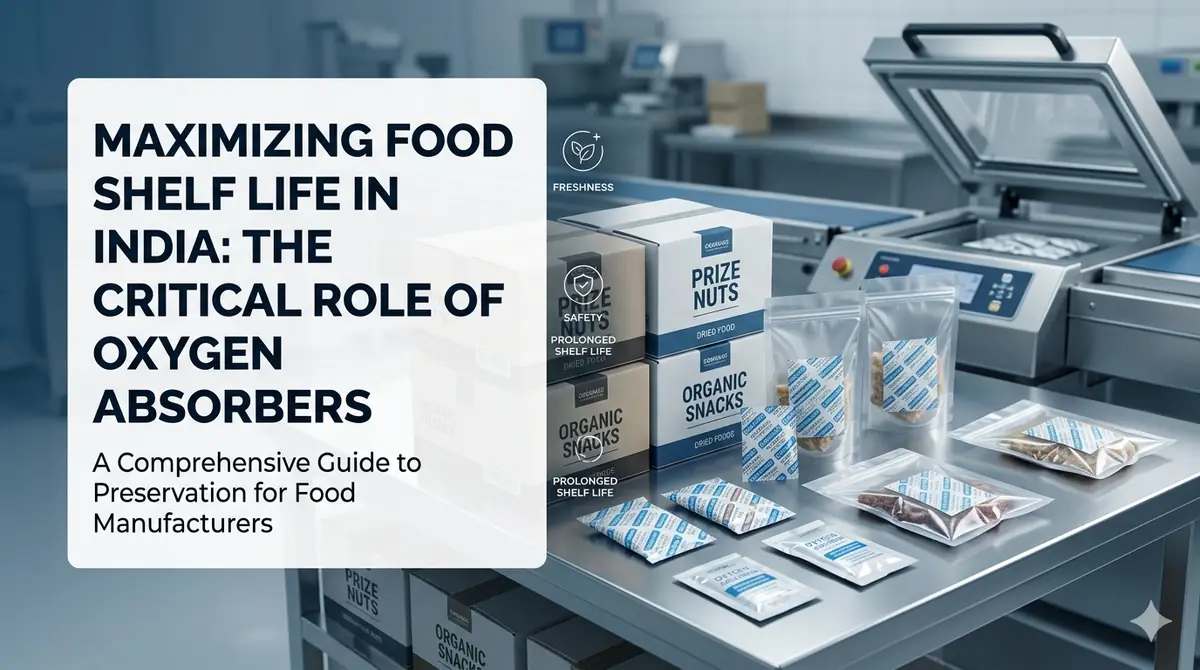
Indian food businesses lose significant revenue annually to product spoilage that oxygen-free packaging could prevent. The mechanism is well-established: oxygen drives three of the four major food degradation pathways. Remove oxygen and most food products last 3 to 5 times longer.
---
The Science of Oxygen Absorbers
Oxygen absorbers contain iron powder and a salt catalyst in a sealed sachet. When exposed to air, the iron oxidises — Fe + O2 → Fe2O3. This reaction consumes oxygen inside the sealed package, reducing the internal atmosphere from 21 percent oxygen to under 0.01 percent.
At under 0.01 percent oxygen:
Aerobic bacteria and mould cannot survive — the major cause of food spoilage is eliminated.
Oxidative rancidity in fats and oils essentially stops — rancid taste and smell development is eliminated.
Vitamin C, E, and A oxidation slows by over 95 percent — nutritional value is preserved.
What oxygen absorbers do NOT prevent: anaerobic bacterial growth (Clostridium and similar — these do not need oxygen). For products where anaerobic spoilage is a risk (wet foods, low-acid foods at room temperature), oxygen absorbers must be combined with refrigeration or other preservation methods.
Upackarts Oxygen Absorbers: upackarts.in/products/oxygen-absorbers/
---
Real Shelf Life Extension Data for Indian Products
Dry spices and masala (standard sealed pouch): 8 to 12 months. With oxygen absorber in foil bag: 4 to 5 years.
Dry fruits (raisins, cashews, almonds in poly bag): 6 to 9 months. With oxygen absorber in foil bag: 3 to 4 years.
Basmati rice (standard bag): 6 to 12 months. With oxygen absorber + sealed foil bag: 4 to 5 years.
Roasted coffee beans (sealed bag): 3 to 6 months. With oxygen absorber in foil bag: 2 to 3 years.
Dehydrated vegetables: 3 to 6 months. With oxygen absorber: 3 to 4 years.
Pharmaceutical tablets (standard blister): 2 years. With oxygen absorber in sealed container: 4 to 5 years.
---
Critical Requirement: Oxygen Barrier Packaging
Oxygen absorbers only work inside sealed, low-oxygen-permeability packaging. The packaging must keep oxygen out as fast as the absorber removes it from the inside.
Compatible packaging: Aluminium foil bags (best), vacuum bags, glass jars with metal lids.
Not compatible: Standard poly bags (LDPE, HDPE) — oxygen permeates through at sufficient rate to saturate the absorber quickly. Corrugated boxes alone — far too permeable.
For oxygen absorber-based preservation: use Upackarts Aluminium Foil Moisture Barrier Bags as the outer package. The foil barrier prevents external oxygen from entering after the absorber has reduced internal oxygen.
---
Capacity Selection
Capacity is measured in cc (cubic centimetres of oxygen the absorber can absorb).
Formula: Required capacity (cc) = Internal headspace volume (ml) x 0.21 (21% O2) + oxygen absorbed from the product itself (varies by product).
Simple rule of thumb for most dry food products with minimal headspace: 50cc absorber for bags under 250ml. 100cc for 250ml to 500ml. 300cc for 500ml to 1 litre. 500cc for 1 to 2 litres.
Add 20 percent safety margin.
Important: Use oxygen absorbers within 30 minutes of opening the master pack — they begin absorbing immediately on air exposure. They generate heat when active — this is normal.
---
Combining with Desiccant
For products where both moisture and oxygen degradation are concerns — spices, nuts, dried fruits, pharmaceutical tablets: use both oxygen absorbers and silica gel desiccant in the same sealed foil bag.
The two products serve different functions: desiccant controls moisture, oxygen absorber controls oxygen. Together, they provide comprehensive preservation.
---
Frequently Asked Questions
Do oxygen absorbers prevent all food spoilage?
Oxygen absorbers prevent aerobic spoilage (mould, aerobic bacteria, oxidative rancidity, vitamin degradation). They do not prevent anaerobic spoilage — Clostridium botulinum, for example, grows in low-oxygen conditions in low-acid, moist foods. For wet foods and low-acid products at room temperature: oxygen absorbers must be combined with refrigeration or acidification.
Why do oxygen absorbers get warm when opened?
Iron powder reacts exothermically with oxygen — the oxidation reaction releases heat. Warmth within 30 to 60 minutes of opening confirms the absorbers are active and functioning. If absorbers are not warm after opening, they may be expired or defective.
How long can oxygen absorbers be stored before use?
Oxygen absorbers in sealed master packs have a shelf life of 6 to 18 months from manufacture. Once the master pack is opened, unused absorbers must be stored in an airtight container with a sacrificial absorber — placing them in a zip lock bag with another absorber that continues to maintain low oxygen inside the storage container.
Need Packaging for Your Business in Pune?
Bulk corrugated boxes, wooden crates, and custom packaging at the best prices. Response in 30 minutes.
Related Articles


Get a Quick Quote
Tell us your requirement. Response in 30 minutes.
Request Quote WhatsApp Now- ✔ Reply in 30 minutes
- ✔ GST Invoice included
- ✔ Bulk pricing available
- ✔ Same-day dispatch, Pune