 Guide
Guide
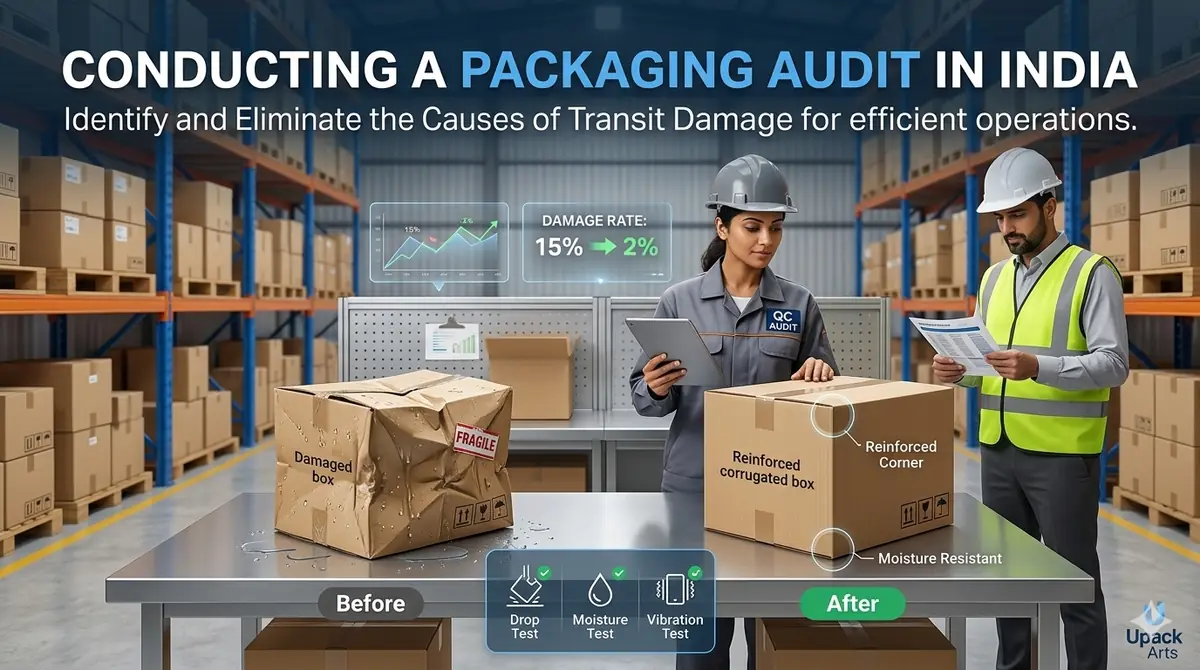
Packaging Audit India: How to Reduce Your Damage Rate to Under 2 Percent
Most Indian businesses do not know their actual packaging damage rate. They know about the returns and complaints that reach them, but the number they track (if at all) is "returns" — which understates actual damage because many damaged shipments are not returned, just not repurchased.
A packaging audit starts with the right measurement, then systematically eliminates each damage root cause.
---
Step 1 — Measure Your True Damage Rate
What to Measure
For courier operations: Return rate from courier damage is one metric, but capture all damage-related contacts — returns, complaints, and re-shipment requests.
For B2B dispatch: Rejection notices and debit memos from customers that cite packaging damage.
For export: Insurance claims and customer damage reports.
How to Track
Open a damage log for 30 days. For every parcel that has any damage complaint or return: record product type, box size used, box ply count, inner protection used, courier/freight company, origin, destination, and damage type (crush, impact, moisture, exposure).
After 30 days: calculate your damage rate (damaged shipments / total shipments x 100) and categorise by damage type.
---
Step 2 — Identify Root Causes by Damage Type
The damage type identifies the root cause:
Crush damage (box compressed, product damaged by compression): Box too weak for weight (wrong ply count or burst factor). Fix: specify correct burst factor by product weight. Reference: 3-ply for under 5 kg, 5-ply for above 5 kg on courier. Upackarts 5-Ply Heavy Duty Corrugated Boxes: upackarts.in/products/5-ply-heavy-duty-corrugated-boxes/
Impact damage (dents, cracks on specific faces): Product moving inside box. Fix: correct box sizing (not oversized) and sufficient void fill to immobilise product. Reference: product should not shift when sealed box is shaken.
Corner damage: No corner protection. Fix: foam corner protectors or corrugated angle boards. Upackarts Foam Corner Protectors: upackarts.in/products/foam-corner-protectors/
Moisture damage: No moisture barrier or desiccant. Fix: HDPE liner + silica gel for domestic, foil bag + desiccant for export. Upackarts Silica Gel Packets: upackarts.in/products/silica-gel-packets-packaging/
Exposure damage (contents accessible, seal failed): Incorrect sealing (single strip, wrong tape width). Fix: H-tape method, correct micron BOPP tape. Upackarts BOPP Packing Tapes: upackarts.in/products/bopp-packing-tapes/
Surface scratching or marks: No surface protection, foam or paper in direct contact with polished surface. Fix: tissue paper first, then foam over. Upackarts Tissue Wrapping Paper: upackarts.in/products/tissue-wrapping-paper/
---
Step 3 — Fix Root Causes in Order of Frequency
Address the highest-frequency root cause first. If 60 percent of damage events are crush damage: fix box specification before addressing moisture or corner damage. Fixing the wrong root cause first wastes budget and does not meaningfully reduce damage rate.
---
Step 4 — Establish and Document Packaging Standards
After identifying and fixing each root cause, write down the packaging specification for each product category:
Product weight range, box dimensions, ply count, burst factor, inner protection (foam, bubble wrap, void fill type and quantity), sealing method (H-tape or single strip), label requirements, and desiccant requirements.
This becomes your packaging SOP (Standard Operating Procedure). Train every packaging staff member on the SOP. The most common source of packaging inconsistency in Indian operations is reliance on individual judgment rather than documented standards.
---
Step 5 — Benchmark and Monitor
Target: under 2 percent overall damage rate for standard domestic courier operations. Under 1 percent for premium e-commerce operations with consistent packaging SOPs.
Monitor monthly. Any month where damage rate increases triggers a root cause investigation — something in the packaging system has changed (new supplier, different box grade, changed product weight range, new courier).
---
Complete Packaging Product Range from Upackarts
Corrugated Boxes: upackarts.in/products/3-ply-corrugated-boxes/ and upackarts.in/products/5-ply-heavy-duty-corrugated-boxes/
Foam Sheets: upackarts.in/products/foam-sheets-rolls/
Corner Protectors: upackarts.in/products/foam-corner-protectors/
Silica Gel: upackarts.in/products/silica-gel-packets-packaging/
BOPP Tape: upackarts.in/products/bopp-packing-tapes/
All 60+ packaging products: upackarts.in/products.php
GST invoice. Delivery across India in 3 to 4 working days. WhatsApp +91-88560-64045.
---
Frequently Asked Questions
What is a good packaging damage rate for Indian e-commerce?
Under 2 percent is achievable for standard domestic courier operations with correct packaging specifications. Most Indian e-commerce operations run at 4 to 8 percent — the gap between current and achievable is entirely from preventable root causes. Under 1 percent is achievable for premium operations with consistent packaging SOPs.
How long does a packaging audit take?
A basic 30-day damage tracking period to collect data, plus 1 to 2 days to analyse root causes and create a remediation plan. Implementation of fixes (updating packaging specifications and ordering corrected materials) takes 1 to 2 weeks. First measurable damage rate improvement: typically visible within 30 days of implementing the fixes.
How do I calculate my cost savings from reducing damage rate?
Current damage rate x shipment volume x (product value + reverse logistics cost) = current annual damage cost. Target damage rate (2%) x same = target annual damage cost. The difference is the annual saving from improving packaging. For most operations: saving Rs. 2 to Rs. 10 lakhs annually is achievable, with packaging investment payback in under 3 months.
Need Packaging for Your Business in Pune?
Bulk corrugated boxes, wooden crates, and custom packaging at the best prices. Response in 30 minutes.
Related Articles

Get a Quick Quote
Tell us your requirement. Response in 30 minutes.
Request Quote WhatsApp Now- ✔ Reply in 30 minutes
- ✔ GST Invoice included
- ✔ Bulk pricing available
- ✔ Same-day dispatch, Pune