 Guide
Guide
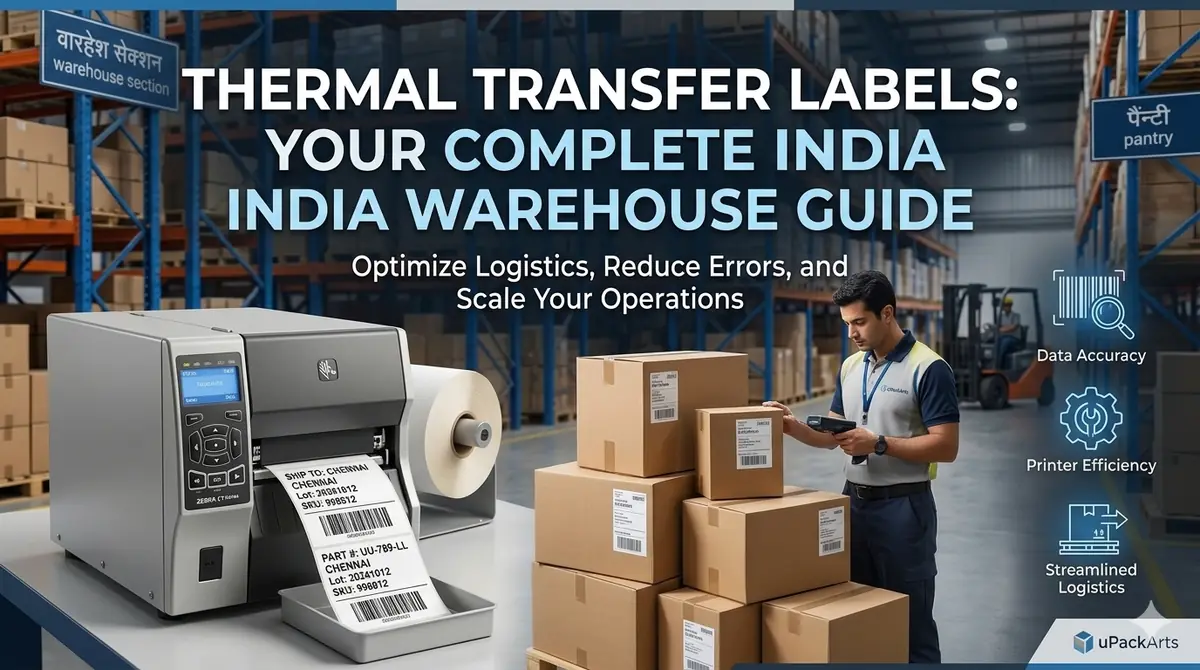
Thermal Transfer Barcode Labels India: Warehouse and Inventory Management Guide
Warehouse inventory accuracy depends on one thing: barcode labels that scan reliably every time. Labels that fade, smear, or lose adhesion create inventory discrepancies — missed scans, ghost inventory, and picking errors — that cost more in operational time than the labels themselves.
This guide covers the thermal transfer label system used in Indian warehouse and manufacturing operations.
---
Why Direct Thermal Fails in Indian Warehouses
Direct thermal labels react to printhead heat — no ribbon needed. The print looks sharp when new. The problem: direct thermal is thermochromic, meaning it reacts to heat. In Indian warehouse environments:
Summer temperatures above 40°C cause direct thermal labels to darken gradually — barcode contrast decreases.
Near heat sources (loading dock direct sunlight, adjacent machinery, shrink tunnel areas): labels can become entirely black within days.
Chemical exposure (common in warehouses with cleaning chemicals, solvent-based lubricants): direct thermal degrades rapidly.
For shelf-life above 3 months or exposure to heat, chemicals, or sunlight: thermal transfer is the correct choice.
Upackarts Thermal Transfer Barcode Labels: upackarts.in/products/thermal-transfer-barcode-labels/
---
How Thermal Transfer Works
Thermal transfer printing uses a ribbon coated with wax, resin, or wax-resin blend. The printhead melts ink from the ribbon onto the label surface — permanently bonding the image.
The result: UV-stable, heat-stable, chemical-resistant print that remains scannable for the life of the label material (typically 3 to 10 years).
---
Ribbon Selection
Wax ribbon: For standard paper labels in indoor environments. Most economical. Print resistant to light abrasion and moisture.
Wax-resin ribbon: For coated paper and synthetic labels in moderately harsh conditions. Better smear resistance and slightly higher heat tolerance than standard wax.
Full resin ribbon: For polyester (PET) labels in harsh conditions — chemical exposure, outdoor use, extreme temperatures, autoclave environments. Most durable, highest cost. For asset tags, outdoor location labels, and chemical-resistant labels.
Match ribbon to label material — using a wax ribbon on a polyester label gives poor print quality and adhesion. Using a full resin ribbon on plain paper is cost waste.
---
Label Substrate Selection for Indian Conditions
Coated paper: Standard for ambient-temperature warehouse inventory labels in indoor conditions. Most economical. Good printability.
Polypropylene (PP): For cold storage warehouses (below 10°C) where paper labels lose adhesion. For humid warehouses where condensation on boxes causes paper label adhesion failure. For labels cleaned periodically.
Polyester (PET): For permanent asset tags, machine nameplates, outdoor location labels, and any label requiring 5+ years durability.
---
Barcode Size and Quiet Zone Requirements
The most common cause of barcode scan failure in Indian warehouses: barcode too small or quiet zone (the white space around the barcode) is not sufficient.
Minimum barcode width for reliable handheld scanner reading: 25mm for Code 128, 30mm for QR code, 15mm for EAN-13 type.
Minimum quiet zone: 10% of barcode width on each side for 1D barcodes. 4 modules on each side for QR codes.
Common label size for warehouse: 75x50mm for standard inventory tags (barcode + product code + description). 100x50mm for location labels (barcode + aisle/rack/level).
---
Frequently Asked Questions
Can I use the same thermal label printer for both direct thermal and thermal transfer?
Many desktop thermal printers are dual-mode — they support both direct thermal (no ribbon) and thermal transfer (with ribbon) by switching the ribbon in and out. Zebra, TSC, Godex, and most commercial thermal printers support dual mode. Check your specific model.
What label size should I use for warehouse location labels?
100x50mm (4-inch x 2-inch) is the standard for warehouse rack location labels in Indian operations — large enough to include the barcode and human-readable text visible from the aisle, with a polyester substrate for 5+ year durability. Use white polyester for reflective visibility in lower-light storage areas.
How often should warehouse barcode labels be replaced?
Thermal transfer labels on polyester substrate: 5 to 10 years. Paper thermal transfer: 2 to 5 years in normal conditions. Direct thermal paper: 6 to 18 months. Replace any label where the barcode scan failure rate exceeds 0.5% — rescan requirements reduce picker productivity significantly at scale.
Need Packaging for Your Business in Pune?
Bulk corrugated boxes, wooden crates, and custom packaging at the best prices. Response in 30 minutes.
Related Articles


Get a Quick Quote
Tell us your requirement. Response in 30 minutes.
Request Quote WhatsApp Now- ✔ Reply in 30 minutes
- ✔ GST Invoice included
- ✔ Bulk pricing available
- ✔ Same-day dispatch, Pune