 Guide
Guide
Tissue Wrapping Paper vs Foam Sheet: Which for Polished and Premium Products India
Polished metal surfaces, silver jewellery, ceramic glazed ware, lacquered wood, and anodised aluminium all share the same packaging vulnerability: the surface is hard but the finish is soft. A transit vibration that would be harmless for an unfinished component creates micro-scratches on a polished surface.
The choice between tissue paper and foam sheet determines whether products arrive in pristine condition or with surface marks that cannot be removed.
---
Why Standard Packaging Materials Scratch Polished Surfaces
Kraft paper (60 to 80 GSM) has a surface roughness equivalent to fine sandpaper under contact pressure during transit vibration. A polished metal component wrapped in kraft paper and shipped by road freight over 500 km will show visible scratch marks on arrival.
Standard EPE foam sheet has a cell structure that creates micro-pressure points at the cell boundaries. On smooth, polished surfaces over extended transit vibration, these micro-pressure points create an embossed pattern on soft metal finishes like gold plating, anodised aluminium, and brushed stainless.
Bubble wrap leaves bubble imprint marks on polished surfaces under pressure.
---
Tissue Paper — The Surface-Contact Wrap
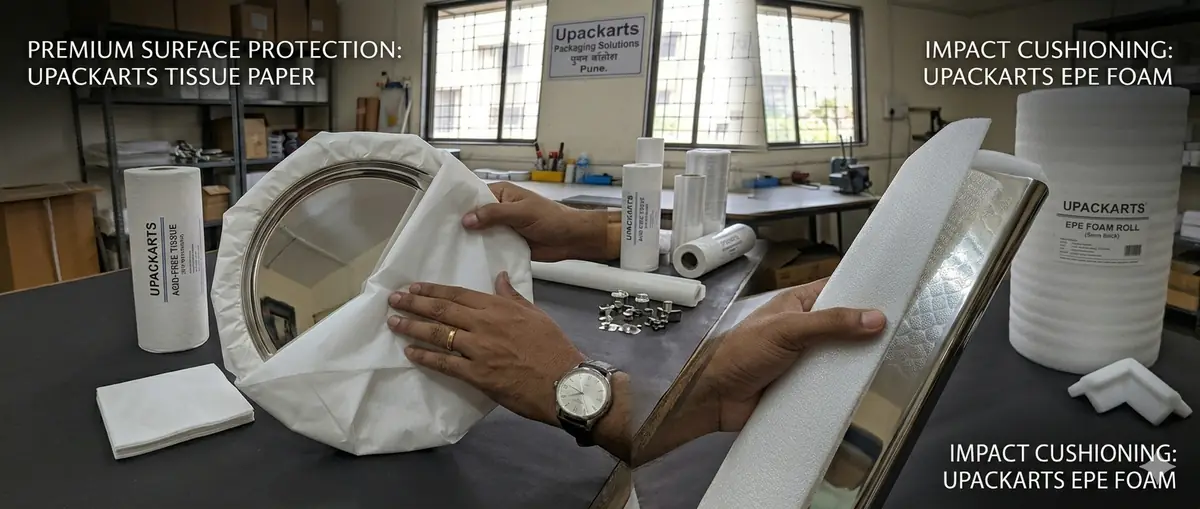
17 to 20 GSM acid-free tissue paper has a surface smoother than any other packaging material at its weight class. It slides against polished surfaces rather than abrading them.
Acid-Free Grade Is Not Optional for Silver and White Metals
Standard tissue paper is slightly acidic from bleaching agents. In direct contact with silver, silver-plated, or white metal surfaces for weeks or months, the mild acid causes silver sulphide tarnishing — the black discolouration most associated with stored silverware.
Acid-free tissue (pH 7.0 to 8.5) is chemically neutral. It does not cause tarnish regardless of storage duration.
For silver jewellery, silverware, silver-plated items, and white metal accessories: acid-free tissue is the required wrapping material, not a premium option.
Upackarts Tissue Wrapping Paper: upackarts.in/products/tissue-wrapping-paper/
---
Foam Sheet — The Cushioning Wrap
EPE foam sheet provides genuine cushioning — energy absorption through compression deformation. Tissue paper provides surface protection but negligible cushioning. For products that need both surface protection and cushioning:
Step 1: Wrap the polished surface in tissue paper. The tissue contacts the surface directly — smooth and chemically neutral.
Step 2: Wrap the tissue-wrapped product in foam sheet. The foam provides cushioning against drops and impacts without contacting the polished surface directly.
This two-layer approach is standard for high-value precision instruments, premium decorative goods, and export jewellery.
Upackarts Foam Sheets and Rolls: upackarts.in/products/foam-sheets-rolls/
---
Application by Product Type
Silver jewellery and silverware: Acid-free tissue directly on the silver surface. Then bubble wrap or foam outer layer for physical protection. Consider anti-tarnish paper strips inside the sealed box. Upackarts Anti-Tarnish Paper Strips: upackarts.in/products/anti-tarnish-paper-strips/
Polished stainless steel components: Tissue paper first, then EPE foam wrap. The tissue prevents the foam cell pattern from embossing into the mirror finish during extended transit.
Ceramic with glaze: Tissue paper first, then corrugated paper roll wrap. Never bubble wrap directly on ceramic glaze — bubble imprint marks are common.
Lacquered wood furniture components: Tissue or glassine paper first (tissue slides; glassine has even higher smoothness for very sensitive lacquers). Then foam sheet or corrugated paper outer wrap.
Premium D2C product presentation: Tissue paper wrapping inside the box creates an unboxing experience before the product is seen. Combined with crinkle cut shredded paper as a base, tissue wrapping signals premium quality.
Upackarts Crinkle Cut Shredded Paper: upackarts.in/products/crinkle-cut-shredded-paper/
---
Frequently Asked Questions
Why does foam sheet leave marks on polished metal?
EPE foam cells create micro-pressure points at cell boundaries. Under sustained contact pressure during transit vibration, these micro-pressure points create an embossed pattern on soft polished surfaces like anodised aluminium, gold plating, and brushed stainless steel. Wrapping the polished surface in tissue paper first prevents direct foam-to-surface contact.
What is acid-free tissue paper and why does it matter for silver?
Acid-free tissue paper has a pH of 7.0 to 8.5 — chemically neutral. Standard tissue paper is slightly acidic from processing. Silver tarnishes when exposed to mild acids over time. For any silver product — jewellery, silverware, silver-plated items — use acid-free tissue only.
Can I use tissue paper as the only protection for fragile items?
Tissue paper provides minimal cushioning — it is a surface protection wrap, not a shock-absorbing material. For fragile items like glassware, ceramics, and instruments, tissue paper protects the surface finish but must be combined with foam sheet, bubble wrap, or foam corner protectors for actual drop and impact protection.
Need Packaging for Your Business in Pune?
Bulk corrugated boxes, wooden crates, and custom packaging at the best prices. Response in 30 minutes.
Related Articles
Get a Quick Quote
Tell us your requirement. Response in 30 minutes.
Request Quote WhatsApp Now- ✔ Reply in 30 minutes
- ✔ GST Invoice included
- ✔ Bulk pricing available
- ✔ Same-day dispatch, Pune