 Guide
Guide
Vacuum Sealer Bags India: Food Preservation and Industrial Storage Guide
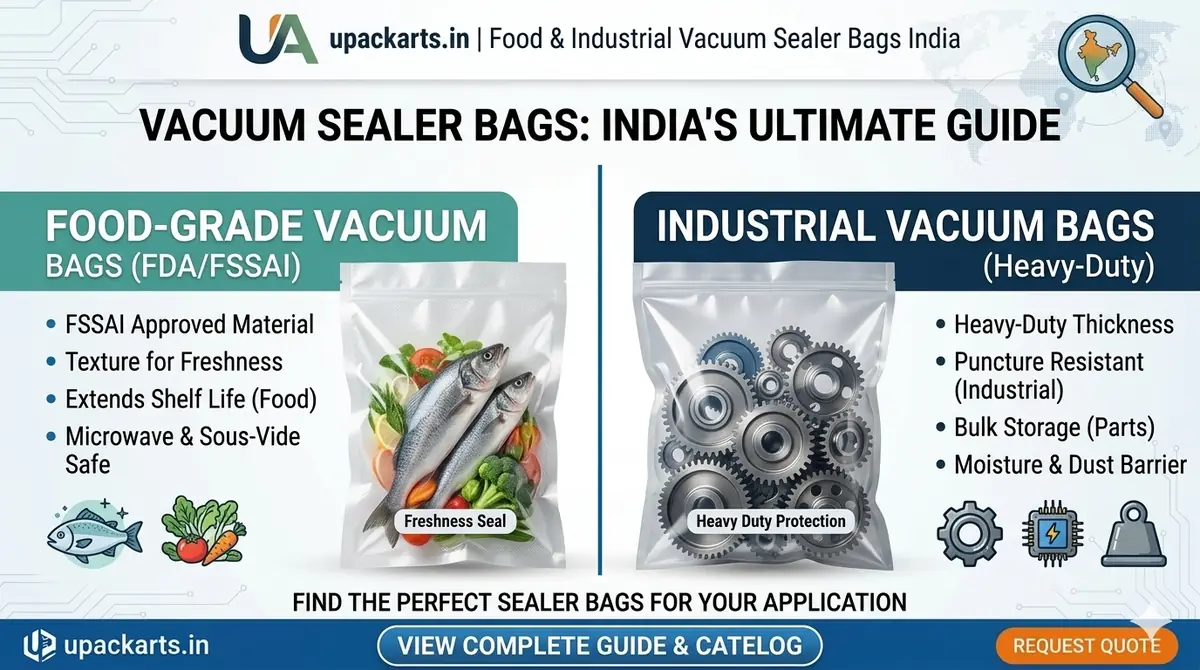
Vacuum sealing removes oxygen from sealed packages, dramatically slowing every oxygen-dependent degradation process — microbial spoilage, oxidative rancidity, corrosion, and vitamin breakdown. The result is predictable: shelf life extends 3 to 5 times for food products, and corrosion protection extends years for metal components.
---
How Vacuum Bags Work
Vacuum sealer bags are textured nylon-polyethylene laminate. The textured (embossed) inner surface creates channels for air evacuation when the bag is placed in a vacuum sealer. The machine evacuates air through these channels and then heat-seals the bag opening.
The resulting package has less than 1 percent residual oxygen — compared to 21 percent in standard sealed packaging.
---
Food Preservation Applications in India
The shelf life extensions are significant:
Dry spices and masala: 1 year in standard sealed pouch → 4 to 5 years vacuum sealed.
Dry fruits and nuts: 6 to 12 months → 3 to 5 years.
Rice and grains: 6 months → 4 years (with oxygen absorber supplement).
Coffee and tea: 3 to 6 months → 2 to 3 years.
Cured meats and paneer: 5 to 7 days refrigerated → 25 to 30 days vacuum refrigerated.
For food businesses: vacuum packaging directly translates to reduced wastage, longer sell-by dates, and ability to buy in bulk without spoilage.
Upackarts Vacuum Sealer Bags: upackarts.in/products/vacuum-sealer-bags/
---
Industrial Applications: Metal Component Storage
Machined metal components stored in warehouses oxidise and corrode during the storage period between production and dispatch or installation. The corrosion rate depends directly on oxygen and moisture availability.
Vacuum sealing machined components (inside VCI-treated or plain vacuum bags) removes the oxygen required for corrosion. Combined with VCI rust preventive paper or a VCI insert, vacuum-sealed components have corrosion-free storage life of 2 to 5 years — compared to 1 to 6 months for standard poly bag storage in humid Indian conditions.
Upackarts VCI Rust Preventive Paper: upackarts.in/products/vci-rust-preventive-paper/
---
Garment and Textile Compression
High-loft textiles — down jackets, duvets, thick blankets, pillows — compress by 60 to 80 percent in vacuum storage bags. A duvet that occupies 40 litres at standard packing compresses to 8 to 16 litres in a vacuum bag.
For garment exporters shipping internationally: vacuum-compressed clothing in standard cartons eliminates the need for oversized boxes and reduces international shipping dimensional weight significantly.
---
Choosing a Vacuum Sealer Machine
Channel vacuum sealers: Rs. 2,000 to Rs. 15,000. The bag's textured channels allow air evacuation. For home, small business, and low-volume industrial use.
Chamber vacuum sealers: Rs. 25,000 to Rs. 2,50,000. More powerful — suitable for industrial volumes and wet/moist products. For food processing businesses above 30 seals per day.
External clamp sealers: Rs. 800 to Rs. 3,500. The simplest type — press the bag opening into the sealer bar. Only works with bags that have accessible open ends.
---
Frequently Asked Questions
How much do vacuum bags extend food shelf life in India?
For dry products: 3 to 5x shelf life extension. Spices vacuum-sealed last 4 to 5 years vs 1 year unsealed. For refrigerated moist foods: vacuum packaging extends refrigerated shelf life 3 to 5 times. The extension depends on the product's moisture content, storage temperature, and whether oxygen absorbers are added.
Can vacuum bags be used for oily or wet foods?
Yes, with a chamber vacuum sealer. Channel sealers cannot handle moist or oily foods because the liquid is drawn into the sealing channel during evacuation. Chamber sealers evacuate by reducing pressure in the entire chamber, keeping liquid inside the bag.
What is the difference between vacuum bags and mylar/foil bags?
Vacuum bags (textured nylon-PE): for vacuum sealing with a machine — the texture creates evacuation channels. Mylar foil bags (aluminium foil laminate): moisture barrier bags that do not require vacuum — they rely on the foil barrier layer rather than vacuum to reduce oxygen. For longest shelf life, combine vacuum sealing inside a foil bag with an oxygen absorber.
Need Packaging for Your Business in Pune?
Bulk corrugated boxes, wooden crates, and custom packaging at the best prices. Response in 30 minutes.
Related Articles

Get a Quick Quote
Tell us your requirement. Response in 30 minutes.
Request Quote WhatsApp Now- ✔ Reply in 30 minutes
- ✔ GST Invoice included
- ✔ Bulk pricing available
- ✔ Same-day dispatch, Pune