 Guide
Guide
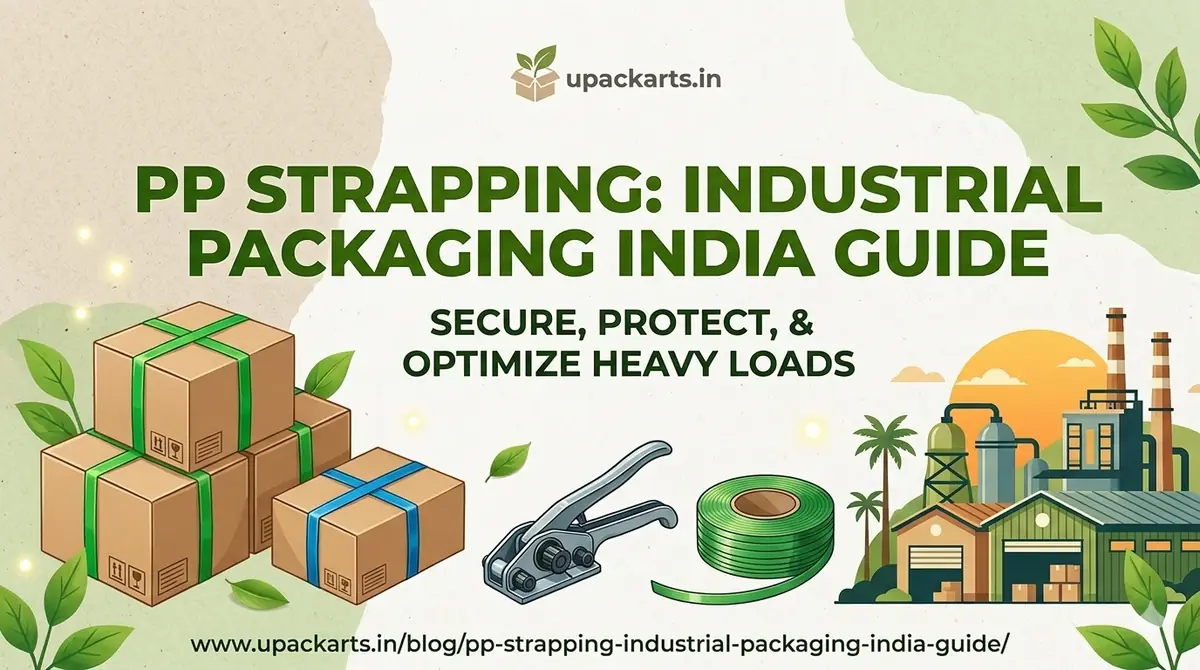
PP Strapping for Industrial Packaging India: Types, Width and How to Choose
Polypropylene (PP) strapping is one of the most widely used securing materials in Indian industrial packaging. It holds corrugated cartons together, secures palletised loads, reinforces wooden crates, and bundles products for dispatch. Used correctly, it is inexpensive and reliable. Used incorrectly, it fails at the worst possible time — when a load topples in a truck or a carton falls apart on the conveyor belt.
This guide covers everything manufacturers, warehouse managers, and packaging buyers need to know before ordering PP strapping.
---
What Is PP Strapping?
PP strapping (polypropylene strapping) is a flat band made from oriented polypropylene resin. The manufacturing process orients the polymer chains along the length of the strap, giving it high tensile strength along its length while keeping it lightweight and flexible.
PP strapping is available in roll form and is applied using a manual strapping tool, battery-powered strapping tool, or automatic strapping machine. It is secured using metal clips (seals) or plastic friction buckles, depending on the application.
---
PP Strapping Width Guide
Width is the most critical specification. Using the wrong width either means insufficient holding strength (load fails) or unnecessary cost (oversized strap for a light application).
12mm PP Strapping
Breaking strength: 150 to 200 kg depending on grade.
Use for: Light corrugated boxes under 10 kg, bundling of small products, securing cartons on light pallets, reinforcing standard shipper boxes.
Standard in: E-commerce fulfillment, FMCG dispatch, pharmaceutical distribution.
15mm PP Strapping
Breaking strength: 250 to 350 kg depending on grade.
Use for: Medium corrugated boxes 10 to 25 kg, standard industrial pallets up to 500 kg, reinforcing 5-ply corrugated boxes for road freight.
Standard in: Auto components, general manufacturing, consumer goods.
19mm PP Strapping
Breaking strength: 400 to 550 kg depending on grade.
Use for: Heavy pallets above 500 kg, wooden crates and export packaging, securing large machinery components, high-value loads where strap failure is not acceptable.
Standard in: Export packaging, machinery dispatch, construction materials.
---
Metal Clips vs Plastic Buckles
Metal Seals (Wire Buckles / Clips)
Metal seals are crimped around the overlapping ends of the PP strap using a sealing tool. They provide the strongest, most secure joint — the joint strength is typically 70 to 80 percent of the strap's breaking strength.
Use when: Maximum holding strength is required. For heavy pallets, export packaging, and applications where the strap will be under sustained load for days or weeks during transit.
Plastic Friction Buckles
Plastic buckles clip onto the strap without tools. Faster to apply but lower joint efficiency — typically 50 to 60 percent of strap breaking strength.
Use when: Light applications where speed of packing is more important than maximum holding strength. For corrugated box bundles and light pallets under 200 kg.
---
Hand Strapping vs Machine Strapping
Manual Hand Strapping Tool
A handheld tool that tensions and seals the PP strap in two operations. Standard in most Indian factories and warehouses. No power required. Works with both metal seals and plastic buckles.
Cost: Rs. 1,200 to Rs. 3,500 per tool.
Use for: Less than 100 strapping operations per day.
Battery-Powered Strapping Tool
Applies consistent tension automatically. Faster and more consistent than manual tools. Suitable for 100 to 500 strapping operations per day.
Cost: Rs. 15,000 to Rs. 45,000.
Automatic Strapping Machine
Fully automated strapping machine where the product passes through a strapping arch. Typically integrated into packaging lines. For above 500 strapping operations per day.
Cost: Rs. 1.5 to Rs. 8 lakhs depending on specification.
---
How to Apply PP Strapping Correctly
Wrong strapping is worse than no strapping — it gives false confidence while providing no real load security.
Rule 1 — Strap position: Horizontal straps should be placed at the lower third and upper third of the pallet height. Never just at the top or just at the bottom.
Rule 2 — Tension: The strap should be tensioned enough that you cannot slide a finger under it. Under-tensioned strapping provides no useful restraint.
Rule 3 — Corner protection: For corrugated boxes on pallets, place angle boards at the four pallet corners before strapping. Strapping directly on corrugated corners cuts into the box and damages the top layer of product.
Rule 4 — Direction: Apply straps in both directions (around the long axis and around the short axis of the pallet) for maximum load stability. Two straps in the same direction provides far less stability than one strap in each direction.
Upackarts Angle Boards (use before PP strapping): upackarts.in/products/angle-boards/
---
Products from Upackarts
PP Straps and Clips: upackarts.in/products/pp-straps-clips/
Angle Boards: upackarts.in/products/angle-boards/
Stretch Film (use with PP strapping for full pallet security): upackarts.in/products/stretch-film/
Wooden Pallets: upackarts.in/products/wooden-pallets/
Delivery across India within 3 to 4 working days. GST invoice. WhatsApp +91-88560-64045.
---
Frequently Asked Questions
What width PP strapping should I use for pallets?
Use 15mm PP strapping for standard industrial pallets up to 500 kg. Use 19mm for heavy pallets above 500 kg, wooden export crates, and high-value shipments. Use 12mm for light corrugated box bundles and pallets under 200 kg.
What is the difference between metal seals and plastic buckles for PP strapping?
Metal seals are crimped around the strap overlap and provide 70 to 80 percent of the strap's breaking strength — they are stronger and more secure. Plastic friction buckles clip on without tools and are faster to apply but provide only 50 to 60 percent joint efficiency. Use metal seals for heavy and high-value loads.
Can I use PP strapping directly on corrugated boxes?
You should use angle boards (edge protectors) at the corners of the corrugated box before applying PP strapping. Without angle boards, the strapping cuts into the corrugated corner, damaging both the box and the top layer of product inside.
Need Packaging for Your Business in Pune?
Bulk corrugated boxes, wooden crates, and custom packaging at the best prices. Response in 30 minutes.
Related Articles
Get a Quick Quote
Tell us your requirement. Response in 30 minutes.
Request Quote WhatsApp Now- ✔ Reply in 30 minutes
- ✔ GST Invoice included
- ✔ Bulk pricing available
- ✔ Same-day dispatch, Pune